
Showing posts with label 2 Stars. Show all posts
Showing posts with label 2 Stars. Show all posts
Wednesday, October 10, 2012
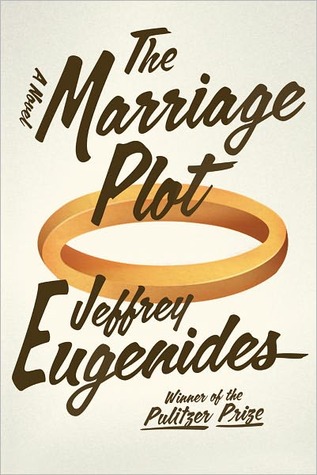
The Marriage Plot - Jeffrey Euginedes

Tuesday, April 24, 2012

Wednesday, January 5, 2011
The Man Who Loved Books Too Much - Allison Hoover Bartlett

This book is basically an expanded magazine story that is not worth reading. I won't bother posting an excerpt since I do not recommend spending your time on this one. It sounded like an intriguing detective story that would also shed light on the world of rare book collectors. Unfortunately, the central character is an identity thief who uses others credit card to steal books. He has no redeeming qualities and not someone I can imagine anyone wanting to learn about. The author's ethics are as questionable as the thief's as she allows the crimes to continue with the justification that she has no legal duty to report the thief.
Tuesday, September 28, 2010
Atonement - Ian McEwan
 In the early evening, high-altitude clouds in the western sky formed a thin yellow wash which became richer over the hour, and then thickened until a filtered orange glow hung above the giant crests of parkland trees; the leaves became nutty brown, the branches glimpsed among the foliage oily black, and the desiccated grasses took on the colors of the sky. A Fauvist dedicated to improbable color might have imagined a landscape this way, especially once sky and ground took on a reddish bloom and the swollen trunks of elderly oaks became so black they began to look blue. Though the sun was weakening as it dropped, the temperature seemed to rise because the breeze that had brought faint relief all day had faded, and now the air was still and heavy.
I have greatly enjoyed other books by McEwan, but this one left me disappointed. I didn't see the major motion picture and am not likely to do so now. This book is much longer than other McEwan books I have read and might be improved if half of it was cut out. The author is a great writer, but seems to have spent too much time focused on writing more than the characters or the story. McEwan's books involve deep emotions, but in Atonement, these are buried under too many words and unnecessary descriptions. I debated all the way through my reading to whether to stop reading or continue. I finished the book, but am not sure I made the right decision. However, don't hesitate to read other books by McEwan which are excellent.
Wednesday, June 9, 2010
Manhood for Amateurs - Michael Chabon
 One spring afternoon when I was fifteen years old, a kid who was new to the tenth grade showed up at our front door unannounced, with a backgammon set folded under his arm. I had no talent for backgammon or friend-making. I hated games that, like backgammon or the making of friends, depended in any way on a roll of the dice or a gift for seizing opportunities. I disliked surprises and all changes of plans, even changes for the better--except in retrospect. At the art of retrospection I was a young grandmaster. (If only there were a game whose winning required a gift for the identification of missed opportunities and of things lost and irrecoverable, a knack for the belated recognition of truths, for the exploitation of chance in imagination after it is too late!) True, I might have felt some disposition to like this kid already, but I would have dared to act upon it.
I must confess, I don't generally like confessionals and this book did nothing to change my mind. The writer has received so much acclaim that I thought I would start by reading this book, his newest. A mistake! The book is a collection of random thoughts in short chapters. They are supposedly grouped in some order, but I failed to see any relationship between the pieces grouped together. Even worse, many of the writings have little to do with the book's title. The chapters discuss often meaningless and/or uninteresting events and thoughts by the author which I guess he assumes the rest of us would find interesting. Some recollections had simple morals similar to those in simple self-help books. Others didn't seem to have any purpose. Creative writing gone amuck.
Wednesday, May 19, 2010
The Nothing That Is - Robert Kaplan
 We may just now have walked past the whole point of our story...For all our thought, not only the mathematical with its recursive abstracting, is drawn toward formalism, as if our having drained it of the human made it god-like. Only after we've sold our souls to this figure do we realize that its hollow, adding nothing to what we knew and by multiplying apercus out to vast generalities, liable to set our understanding at nothing. Is this where the Great Paradigm was leading us- or is formalism rather an occupational hazard of the mind, which is prone to mistake the ever-enlarging context within which content is held for the disappearance of content altogether? So, the signs that facilitate thinking eventually come to be taken for its substance.
I really wanted, and fully expected, to enjoy this book, but I came away disappointed. I am curious and appreciative of history and mathematics. A history of the zero seemed a perfect read for me. The book fails in both its history and its math. It claims that only a basic understanding of high school math is required to understand the concepts in the book. As someone who has taken calculus at the college level, I found much of the math difficult to comprehend. Even worse, it didn't to be directly related to the history of the zero, but simply the author taking liberties to venture off in his own areas of interest. The book fails more so in the area of history. The actual history of the zero does not make up a majority of the book. It seems the actual history could have been covered in a chapter or two.
This is an academic treatise that is likely to only appeal to fellow academicians.
Thursday, April 22, 2010
Tomorrow - Graham Swift
 You're asleep, my angels, I assume. So, to my amazement and relief, is your father, like a man finding it in him ot sleep on the eve of his execution. He'll need all he can muster tomorrow. I'm the only one awake in this house on this night before the day that will change all our lives. Though it's already that day: the little luminous hands on my alarm clock (which I haven't set) show just gone one in the morning. And the nights are short. It's almost midsummer 1995. It's a week past your sixteenth birthday.
What a disappointing read from an author who has won many literary awards! This book all takes place during one woman's sleepless night in bed. She is worried about a discussion with her 16 year-old twin the next morning. The entire book is a first person imaginary dialogue with the children. While that premise might work as she looks back at life, it doesn't work in this book. The reader is kept waiting until halfway through the book to discover the big secret. Getting there is tedious reading and it gets worse after the secret is disclosed. The woman is an unlikable mother with little compassion or understanding. Her first person dialogue is completely unbelievable when it covers frequent and in-details of her sex life both within and outsider her marriage to their father. Can anyone imagine telling their teenage son and daughter, whom she describes as virgins, about her experiences in different sexual positions, the volume and type of her screaming orgasms, or how fluids seep out.
And it isn't just unrealistic sexual discussions, there are boring pages about a cat and a one-night affair. I was actually shocked by the woman's (or the author's?) comments about a non-genetic father's ability to be a father. Cold and Callous? Yes. Worth reading? Definitely not!
Wednesday, April 7, 2010
Bone Fire - Mark Spragg
 The night after Claire gave him the iPod he fell asleep listening to the Red Hot Chili Peppers, waking in the middle of the night with a headache, the buzzing in his chest so acute that he lifted his T-shirt to see what was going on. After that, he let it charge while he slept.
He wore the earbuds during the day when they couldn't find enough for him to do or he got bored shooting baskets, and when he'd heard all the songs three times and they started cycling through again, he pushed the double dash to make it stop. On the evening of his fourteenth day in Laramie, he wrapped the earbud wires in a neat coil around the body of the iPod, laid it out in plain sight beside the computer, then waited.
Don't ask me why I finished this book; nothing in it justifies taking the time to do so. I am curious what grade this professor of creative writing would give a student who turned in this book. It is a poor writing with a disjointed storyline and unsympathetic, cliched characters. There is endless dialogue that is largely pointless. This modern western tale is certainly not one to read after Wallace Stegner, then again, it is not to read following any author.
Wednesday, January 27, 2010
Into the Beautiful North - Luis Alberto Urrea
 Before them, a vast smear of smoke. Not smoke. Birds. Aloft. Suddenly, as one, they turned, vanishing in the air like the louvers of God's own opening window blinds. Appeared. Vanished. Appeared. Swept away to stubbled fields.
 They clattered to a stop in Topeka. They felt like they had sandpaper in their shorts, old glue in their mouths.
I very much enjoyed The Hummingbird's Daughter by this author. After hearing Urrea discuss this book at a bookstore, I expected to enjoy this one. Unfortunately, I can't say I did.
Urrea is a good storyteller in person. This book, however, is not well written and didn't work at all for me. The story has a great premise--women from a small village in Mexico will travel north to get some men to help them drive out some gangsters. I kept reading it, feeling like I do when watching a bad TV sitcom, just to see how an interesting storyline will pan out. That ended up being a huge disappointment when the story doesn't really come to a conclusion, even with an epilogue.
The characters are not well-developed, the book covers a lot of ground, but none too well, it is overburdened with cliches and stereotypes. If you get a chance to see Urrea in person, go, but don't bother with this book.
Tuesday, December 22, 2009
Pilgrims - Garrison Keillor
 The first pilgrims through the International Arrivals portal at Leonardo da Vinci was Margie Krebsbach, face scrubbed, fresh, grinning, towing her husband Carl who looked stunned as if struck by a ball-peen hammer, and then the others came slouching an shuffling along, jet-lagged, brain-dead, and right away she spotted the thin, spiky-haired man in the blue blazer holding up the sign--LAKE WOBEGON--in one hand, high, and she let out a whoop and let go of Carl. "This is so neat!" she said, meaning the sign--the words "Lake Wogegon"--here!--in Italy!--Great God!
 Disappointing! Hard to say when I love listening to Keillor and have enjoyed other writings by him. I was disappointed that the trip to Italy by a group from Wobegon included so little about Italy. Mostly, the book set up situations for the characters to tell stories about Wobegon days. I wondered why it didn't just occur during a family picnic with rounds of story telling. This may have worked better as a collection of short stories. As a novel, it didn't work for me. The story never seems to gain any traction to move forward and I found myself reading just to get to the end.
Thursday, October 2, 2008
The Headmaster's Dilemma - Louis Auchincloss
 And so Michael liked to think about it. He had been headmaster for three years now, appointed as a result of the successful efforts of younger members of the board to convince the others that a leader was needed to make some adaptations to the exigencies of change in educational thinking. And he had already achieved some of these: girls had just been admitted; the limits of courses widened.
The author is a prolific writer who received the National Medal of Arts in 2005. He has published over 60 books. Maybe I picked one of his worst as I can't recommend this book. The story is predicable and full of cliches. The characters are shallow and not differentiated from each other. The dialogue detracts from the characters rather than developing them as unique individuals. Apparently, Auchincloss mostly writes about society's upper class. In this book, the headmaster and his wife are a younger generation being challenged by older conservatives. They are not convincing as written. Don't waste your time with this book.
Tuesday, July 29, 2008
Books - Larry McMurtry
 Here I am, thirty-four chapters into a book that I hope will interest the general or common reader --and yet why should these readers be interested in the fact that in 1958 or so I paid Ted Brown $7.50 for a nice copy of The Anatomy of Melancholy? How many are going to care that I visited the great Seven Gables Bookshop, or dealt with the wily L.A. dealer Max Hunley, who little store at the corner of Rodeo Drive and Little Santa Monica in Beverly Hills is now a yogurt shop....A fair answer would be that few readers are engaged by this kind of stuff, unless the writer can somehow tap deeper sentiments.
Unfortunately, McMurtry fails in his efforts to engage the reader with this so-called memoir. By the time you finish the 98 chapters, many only a half-page long, you feel like a bored listener to stories with no emotional or intellectual impact. If you happen to have a deep-seated interest in the buying and selling of rare books, you may find the book interesting.
The book starts out like a typical memoir with reminiscences of the lack of books in his childhood. The book quickly moves to the writer's adult life with dozens of unconnected tales of books that were bought or sold often for amounts too small or too large. Even the ending comes off as disjointed where it seems that after 95 chapters the writer simply decides to hurry up and end it. McMurtry is a fine writer and this the only saving grace of this book. Very disappointing.
Tuesday, March 4, 2008
Amerigo - Felipe Fernandez-Armesto
 Subtitled- The man who gave his name to America
 He was up to none of the ambitious roles he adopted. He was too unstudious to be a diplomat, too imprudent to be a great merchant, too incompentent to be a navigator, too ignorant to be a cosmographer. When he played the magus, he relied on sleight of hand to get him by.
The author gives us a little information about Amerigo Vespuci which is summed up in the above quote. The book reads like a thesis paper from an author overly impressed with his skills at finding inaccuracies and dispelling any material supportive of Amerigo. I was expecting more of a biography but this book is not that. The book is largely an exercise in showing us how much research the author has done and how he use words few readers will understand without a dictionary. This includes his use of what the Oxford dictionary calls the longest non-technical word in the english language (a word which Alex Trebek on Jeopardy gave up trying to pronounce). If want to learn a some new words, like hagiography (writing about saints) which he uses 5-6 times, get out your dictionary and read this book. Otherwise, read a short bio on Amerigo.
Monday, January 21, 2008
Water for Elephants - Sara Gruen
 This book has a great premise-- a travelling circus struggling during the depression. Throw in an innocent young man with circus people, including a beautiful woman, lots of action and the book has great potential.
Unfortunately, this book fails to reach its potential. The author states that she spent 4 months, wait she actually said 4 and 1/2 months, researching material. It is too bad that the old circus photos are far more interesting and descriptive than her writing. The characters are flat and cliched. We never learn enough about our hero to really get behind him. The reader learns nothing about the woman he falls in love other than the fact she is pretty.
The book takes the form of an old man looking back at a period in his youth. The short chapters with the aged hero mostly reflect on life in nursing homes. I felt this mostly distracted from the main circus story.
I know this book is loved by many, but is not an example of good writing or story-telling. It is more like something you would find serialized in Reader's Digest.
Saturday, January 5, 2008
Severance - Robert Olen Butler
 After careful study and due deliberation it is my opinion the head remains conscious for one minute and a half after decapitation. - Dr. Dassy D’Estaing, 1883
By reading this book, I have answered the question "How can you go wrong reading the work of a Pulitzer Prize winner?" This book didn't work for me. The premise of the book might be a good exercise for a creative writing class, but as a novel it was only mildy engaging.
There are 61 instances of people, or in a few cases animals, which are decapitated either intentionally or accidentally. The author assumes that in the 90 seconds it takes for the brain to shut down, up to 240 words could have been formed. He then writes exactly 240 words in each instance which read like short prose poems.
The book has interesting groupings of individuals, such as several following the French Revolution. The author chooses an interesting aspect of the individual and the time period to reflect upon. While the writing has its moments with intriguing last thoughts, it remains gruesome and lacking in any over-riding theme. Still, it is a quick read and if you want to imagine what goes on in someone's mind after being decapitated, give it a try. I was surprised that the last thoughts were reflective instead of being filled with anger, pain, or shock.
Friday, September 21, 2007
Italy - Rick Steves

I guess a guidebook is only interesting if you are planning a trip. Since we are taking a Rick Steve's Italian trip, the book is enjoyable to read. He writes for the traveller who wants to be a little more adventurous, but still see the sites you always dreamt of. For me the trip begins when I begin reading about it.
Tuesday, August 21, 2007
Dancing to Alemendra - Mayra Montero

An enjoyable read. Interesting characters in 1950's Cuba. Just before the revolution when the casinos and gangsters where in their heyday. Some interesting twist and turns. Read it if you want to get a flavor for the place and times. The book never really engaged me in the story.
Saturday, July 21, 2007
Notes from a Small Island - Bill Bryson


Another of Bryson's casual tales of his travels- this time around Britain. He obviously enjoys Britain much more than America and this book is as positive as his Lost Continent book is negative. It is hard to believe that he can find more pleasure in the wet and barren countryside than he can in Yosemite, but he does. While I haven't been to Great Britain, the book is not as enjoyable of a read as his others. Perhaps if you enjoy British TV shows, you will find more pleasure than I in this book.
Subscribe to:
Posts (Atom)