Sunday, August 8, 2010

Who Do You Love - Jean Thompson

We were headed straight into bad news. The snow had begun sixty miles back as something light and sifting. It raced across the highway in curving snake shapes and slid harmlessly beneath the wheels. By the last exit it was sticking to the road in patches. Just a few miles farther and the pavement turned solid white. The wind was stronger now; it blew at right angles to the highway, kicking up loose snow, filling the air with it. I was driving hunched up against the wheel as close as I could get. Holly said, "I told you, check the forecast."
.
This book of short stories focuses on disappointments in love. Mostly focused on a woman's perspective, they are sad stories on the flip side of the knight in shining armor. Thompson succeeds in crafting unique situations and people having to face an unsatisfying experience. Too often, I found myself not really caring enough about the people and situations. The author has received a lot of recognition and praise for her work, so I guess she appeals to many more so than she did to me.

Monday, August 2, 2010

Austerlitz - W.G. Sebald

Why does time stand eternally still and motionless in one place, and rush headlong by in another? Could we not claim, said Austerlitz, that time itself has been non-concurrent over the centuries and the millenia? It is not long ago, after all, that it began spreading out over everything. And is not human life in many parts of the earth governed to this day less by time than by the weather, and thus by an unquantifiable dimension which disregards linear regularity, does not progress constantly forward but moves in eddies, is marked by episodes of congestion and irruption, recurs in ever-changing form, and evolves in no one knows what direction? Even in a metropolis ruled by time like London, said Austerlitz, it is still possible to be outside time, a state of affairs which until recently was almost as common in backward and forgotten areas of our own country as it use to be in the undiscovered continents overseas.

Sebald is a most fascinating writer. This book takes the reader into a timeless, surreal environment where one man tells another about his life and self-discovery. I read Sebald with an amusement that is strangely comforting knowing that people examine life from his unusual perspective. His writing is rich and complex. This book, like others of his, includes many odd photographs that are as intriguing as the writing. The photos look as if they were taken from old boxes that would be meaningless to anyone other than the photographer who was simply documenting things he had seen. But put in the context of the writing, they too become oddly captivating. Sebald meanders off into science and history unearthing facts and ideas about things you either never knew or had no idea you wanted to know--such as a biological study of moths.

Not for everybody, as many will likely find Sebald's writing too slow paced and lacking in a typical storyline or format. I find myself amongst those that love Sebald and will read more of his work.

Monday, July 26, 2010

Await Your Reply - Dan Chaon

Was he faking it? Miles had never been sure, even as Hayden's behavior became more erratic and abnormal and secretive. There were time, lots of times, when his "illness" felt more like a performance, am amplified version of the games they had been playing all along. The "symptoms" Hayden was supposedly exhibiting, according to the therapist--"elaborate fantasy worlds,""feverish obsessions,""disordered thoughts," and "hallucinatory perceptual changes:--these were not so much different from the way Hayden usually behaved when they were deeply involved in one of their projects. He was, perhaps, a little more exaggerated and theatrical than usual, Miles thought, a little more extreme than Miles felt comfortable with, but then again there were reasons. Their father's death, for example. Their mother's remarriage. Their hated stepfather, Mr. Spady.

This book kept me enthralled and constantly surprised. Three very odd and completely different settings and characters are expertly woven into a compelling mystery. I read the first three chapters with fascination, however they seemed to be completely unconnected. Wondering if and how the author might tie these story lines together, makes the reader want to continue. After the story begins to come together, I found myself compelled to finish the book.
Chaon is an intelligent, creative writer who well deserves all the praise he has received. His writing flows easily, but is deceptively complex. A great mystery, bizarre characters, unimagined connections, a modern theme, great writing and it all adds up to a five star review.

Friday, July 23, 2010

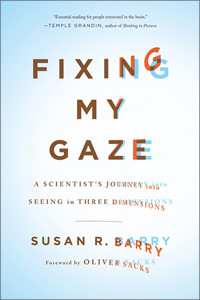
Fixing My Gaze - Susan Barry

Stereoblind? Was I stereoblind? I looked around. The classroom didn't seem entirely flat to me. I knew that the student sitting in front of me was located between me and the blackboard because the student blocked my view of the blackboard. When I looked outside the classroom window, I knew which trees were located further away because they looked smaller than the closer ones. The footpath outside the window appeared to narrow as it extended out into the distance. Through cues like these, I could judge depth and distance. I knew the world was in 3D. Yet, my professor implied that there was another, different way to see space and depth. He called this way of seeing stereopsis. I couldn't imagine what he was talking about.
.
I admit I read this book because of a granddaughter born with vision problems. Susan Barry grew up with eyes that didn't track properly. In spite of surgeries, she did not develop the ability to see three dimensions or stereopsis. It is hard to imagine seeing everything in 2D, but the author does a great job of describing it. As strange as it sounds to most of us, people without stereo vision can't really imagine 3D. This book combines both the biology of vision problems related to eyes tracking and the human effects on those with this problem. Becoming a neurobiologist, the author was in a unique position to write this book after discovering a method to begin seeing 3D at age fifty. The book is certainly a must read if you know anyone a cross-eye or wall-eye. Even if you don't, this short book is very informative and easy to read and understand.

Tuesday, July 20, 2010

Dorothea Lange - Linda Gordon

I have come to think of Lange as a photographer of democracy, and for democracy. She was not alone in this commitment, for she had predecessors and colleagues, and today has many photographic descendants. From her family of origin, her two extraordinary husbands, and friends of great talent she absorbed sensitivity, taste, and technique. These people are part of her enabling context, and for that reason this book includes them as major characters. So too the unique cultures of Hoboken, New York, San Francisco, and Berkeley play major roles in this story.
.
Gordon has written an incredibly researched biography of this icon of American photography. The writing flows and is kept interesting in a book that covers a lot of ground. There are over 120 pages of citations! Lange's life is somewhat challenging to cover, since she did not leave diaries or much writing.
Much of the book covers the social history of the times and persons influential in Lange's life. This is both the strength and weakness of the book. While discussing historically intriguing times and situations, such as the original bohemian movement in SF, the writer seems to sometimes lose track of Lange. The book is a combination social history and biography. I found some of the personal comments and asides in the book irritating, especially a short excerpt from a love letter in which the author inserts a comment in the middle. This is a good book if you want to read about Lange or have an interest in the historical period.

Wednesday, July 7, 2010

Generosity - Richard Powers

True, then: both of Thassa Amzwar's parents are dead. Dead of identity and too much hope. And the daughter is either on newly discovered antidepressants or so permanently traumatized she's giddy. Her writing has that open confidence of a child who might still become an astronaut when she grows up. All her sounds ring, all colors shine. Crippling colonial inheritance, religious psychosis, nighttime raids: she's swept along by the stream, marveling. Her words are naked. Her clauses sprout whatever comes just before wings.
Stone's hands shake as he inks up her assignment.
.
Powers is a wonderful writer who has received a lot of well-deserved praise. This book uses a philosophical question to drive the story rather than the characters. The characters are interesting and the reader becomes engaged in their drama. However, what compels the reader to keep turning the pages is the answer to a question of happiness. Is happiness genetically programmed or is primarily learned and developed? Would it benefit the individual or the world if we artificially created happiness? I liked the way Powers developed different perspectives on happiness. He is thoughtful and articulate. At the same time, he creates a story and characters who become involved in a thrilling drama around the theme. I like the writing and found myself thinking for days about this book--thus it's five star review.

Sunday, July 4, 2010

The Lost Painting - Jonathan Harr

The Biblioteca Hertziana stayed open until nine o'clock every night, and Francesca rarely left before then. At her table, she collected dozens of articles and monographs about Caravaggio and began reading through them. Many offered nothing particularly new or interesting, just the background noise of art scholars going about the business of advancing their opinions or disputing the opinions of their colleagues. Sometimes in an article, a real piece of information--an actual fact, a date, a contract--would emerge from the vast tangled swamps of archives. Then it would be scrutinized and interpreted by the confraternity of Caravaggio scholars, and if it withstood examination, it would assume its place in the assembled landscape of Caravaggio's life.

What a great book! The author does a superb job with a non-fiction tale of art mystery. The search to find a lost Caravaggio painting is fascinating. Research, travel, ancient archives, experts with questionable motives, and one of art's most irascible painters make this a book you won't want to finish. I was amazed at how the author could combine art history, Caravaggio's life, and the world of expert identification of paintings while keeping a mystery moving forward. So often authors lose the impact of a gripping story when they divert into details. Harr is able to seamlessly weave everything together moving from historical facts to the emotions of the investigators. The book would be enjoyable for anyone to read, but if you have any interest in art you will love this book. If you like Caravaggio it is a must read. This is non-fiction at its best.

Saturday, June 26, 2010

13 Bankers - Simon Johnson & James Kwak

The Wall Street banks are the new American oligarchy--a group that gains political power because of its economic power, and then uses that political power for its own benefit. Runaway profits and bonuses in the financial sector were transmuted into political power through campaign contributions and the attraction of the revolving door. But those profits and bonuses also bolstered the credibility and influence of Wall Street; in an era of free market capitalism triumphant, an industry that was making so much money had to be good, and people who were making so much money had to know what they were talking about. Money and ideology were mutually reinforcing.

There is a part of me that doesn't want to take the effort to understand how the people at the top pillaged the rest of us. But after a friend sent me this book, I read it and am glad I did. It tells a story the rest of us need to know. Everyone knows something about the financial crisis that began in 2008. In this book, the authors provide the details of how they did it to us. Extremely well-researched by two top economists, the book tells a compelling story of how it happened and what must happen next to stop the next mass movement of money.

13 Bankers should be a textbook required for reading in economics classes. It is easy to read, although it does bog down at times and I didn't take the time to read the extensive footnotes. The authors did a good jog of making this a readable book and not simply facts thrown together. It mixes in history with action steps for a better future. It is worth your time.

Thursday, June 24, 2010

The Anthologist - Nicholson Baker

...you're determined that this is going to be a real anthology. This isn't going to be one of those anthologies where you sample it and think, Now why is that poem there? No, this is going to be an anthology where every poem you alight on and read, you say to yourself, Holy God dang, that is good. That is so good, and so twisty, and so shadowy, and so chewy, and so boomerangy, that it requires the forging of a new word for "beauty". Rupasnil. It's so good that as soon as you start reading the poem with your eyes you know immediately that you have to restart again reading it in a whisper to yourself so that you can really hear it. So good that you want to set it to musical notes of your own invention. That good.

An intelligent book filled with comments on poets and poetry. Written in the first person, the story involves a poet preparing an anthology of rhyming poetry. The quirky poet (is that redundant?) meanders in his task to finish the book as does the author in presenting thoughts on poetry. It is a fun read, especially if you enjoy poetry. The author not only presents intriguing thoughts about different aspects of poetry but also much of the history of poetry. You may also enjoy this book if you tend to procrastinate as does the main character. Silly at times and tending toward indulgence, I still found the author's story and writing kept me interested and enjoying my time with this book.

Saturday, June 12, 2010

Dancer - Colum McCann

He returns from the wings already in midair, moves through four cabrioles, keeping his line long until the sound catches up, an instant of conjunction, a flash of muscle and he sweeps the stage with his body, owning it, no limits. Eight perfect entrechats-dix, a thing of wonder, the audience silent now, no body anymore no thought no awareness this must be the moment the others call god as if all doors are open everywhere leading to all other open doors nothing but open doors forever no hinges no frames no jambs no edges no shadows this is my soul born weightless born timeless a clock spring broken, he is in flight, he could stay like this forever and he looks out into the haze of necklaces eyeglasses cufflinks shirtfronts and knows he owns them.

I loved this book--one to consider for a small desert island collection. The writing is superb! This is creative non-fiction take on Rudolf Nureyev's life. And what a life it was! Rising from a poor Russian ethic minority to become a ballet dancer that is famous throughout the world is a story worth telling. McCann chooses perfect selections from Nureyev's life to create an experience more real than a typical biography. His portrayal of Rudy's father as a soldier during Russian battles is perhaps the best and most chilling writing I have ever read on war.

The book is startling in its breadth. Nureyev's travels from Russia to Paris to New York to South America help define this immensely complicated person. Rather than telling the reader about life among the famous people in the world, McCann is able to create the scenes that both portray the fame and mold the individual. On top of it all, the love and art of ballet is beautifully and movingly delivered.

Wednesday, June 9, 2010

Kafka Americana - Jonathan Lethem & Carter Scholz

There are numbers between numbers, thinks Stevens. Between the integers are fractions, and between those the irrationals, and so on to the dust f never-quite-continuity. I numerical continuity is an illusion, perhaps temporal continuity is as well. Perhaps there are dark moments between our flickers of consciousness, as between the frames of a movie. The Nude of Duchamp descends her staircase in discrete steps. Where is she between steps? Perhaps here at the hotel. At this moment, stuck between floors, where am I?

An interesting take on Kafka by two writers who write alternating short stories in this book. Interestingly, the SF Library has a signed, limited edition print on its lending shelves. Some excellent writing by both writers. Lots of creativity and humor in this short book. Like the cult icon Kafka, this book falls into that same category. Sometimes it felt like the writers were trying too hard. The book is entertaining reading, especially for those enjoy esoteric, absurb takes on Americana. For short story lovers, this book is an inventive collection with an intriguing theme. For me, the writing made it a very good book.

Manhood for Amateurs - Michael Chabon

One spring afternoon when I was fifteen years old, a kid who was new to the tenth grade showed up at our front door unannounced, with a backgammon set folded under his arm. I had no talent for backgammon or friend-making. I hated games that, like backgammon or the making of friends, depended in any way on a roll of the dice or a gift for seizing opportunities. I disliked surprises and all changes of plans, even changes for the better--except in retrospect. At the art of retrospection I was a young grandmaster. (If only there were a game whose winning required a gift for the identification of missed opportunities and of things lost and irrecoverable, a knack for the belated recognition of truths, for the exploitation of chance in imagination after it is too late!) True, I might have felt some disposition to like this kid already, but I would have dared to act upon it.

I must confess, I don't generally like confessionals and this book did nothing to change my mind. The writer has received so much acclaim that I thought I would start by reading this book, his newest. A mistake! The book is a collection of random thoughts in short chapters. They are supposedly grouped in some order, but I failed to see any relationship between the pieces grouped together. Even worse, many of the writings have little to do with the book's title. The chapters discuss often meaningless and/or uninteresting events and thoughts by the author which I guess he assumes the rest of us would find interesting. Some recollections had simple morals similar to those in simple self-help books. Others didn't seem to have any purpose. Creative writing gone amuck.

Tuesday, June 1, 2010

Bosch - Walter Bosing

"...the like of which was never seen before nor thought of by any other man."
In our own century scholars have come to realize that Bosch's art possesses a more profound significance, and there have been many attempts to explain its origins and meaning. Some writers have seen him as a sort of fifteenth-century Surrealist who dredged up his disturbing forms from the subconscious mind; his name is frequently linked with that of Salvadore Dali. For others, Bosch's art reflects esoteric practices of the Middle Ages, such as alchemy, astrology or witchcraft.

This book is part of a series of art books published by Taschen to celebrate their 25th anniversary. The oversized hardback book is a true bargin selling at $14.95. The quality of the reproductions is good and the text is informative, although written too scholarly for my taste. A little of Sister Wendy's passion thrown into the text would have helped. The text does, however, provide necessary detail to better understand Bosch's art.

Bosch's art is entirely fascinating and this book includes all of the art generally attributed to him. We see in his work both incredible talent and intriguing glimpses into the medival mind. Heaven and hell are the major themes in these works, but nobody else displayed the imagination that created the scenes and creatures Bosch painted in his visions of the afterlife. It is impossible not to stare and become entranced by the amazing detail and strangeness in Bosch's works. How lucky we are that this work survived and that it so affordable to own a book with it.

Monday, May 24, 2010

My Life as a Fake - Peter Carey

The editors of literary magazines, while conceiving of themselves as priests, actually travel like brush salesmen, always making sure they have a sample of their wares packed along with socks and underwear, and it was not at all eccentric of me to bring several issues of "The Modern Review" to Malaysia. One of these had a very fine translation of Stefan George, which I expected a reader of Rilke would admire and so the following morning, at half past six, I wrapped it in some pretty paper and set off back to Jalan Campbell. I had no notion of how this half-mile walk was going to change my life. If I had only stayed in bed, I would not be where I am today, struggling in a web of mystery that I doubt I ever shall untangle.

Suspense and intrigue in an exotic locale make this an enjoyable book. It is very well written with a quick pace that keeps the reader engaged. I am not a big fan of mysteries, but enjoy a well-written one. Throughout the book, I kept second-guessing myself about which character was telling the truth. But the truth as described by two main characters is fascinating in both accounts. While I wanted to know what really happened some years earlier, I almost didn't care because both of the two explanations being offered were fascinating.

Carey does a great job of using the locale of Indonesia and introduces many strange and unusual settings and situations. At times, the story seemed to meander a little too far from the main drama, but didn't detract too much from an excellent book.

Wednesday, May 19, 2010

The Nothing That Is - Robert Kaplan

We may just now have walked past the whole point of our story...For all our thought, not only the mathematical with its recursive abstracting, is drawn toward formalism, as if our having drained it of the human made it god-like. Only after we've sold our souls to this figure do we realize that its hollow, adding nothing to what we knew and by multiplying apercus out to vast generalities, liable to set our understanding at nothing. Is this where the Great Paradigm was leading us- or is formalism rather an occupational hazard of the mind, which is prone to mistake the ever-enlarging context within which content is held for the disappearance of content altogether? So, the signs that facilitate thinking eventually come to be taken for its substance.

I really wanted, and fully expected, to enjoy this book, but I came away disappointed. I am curious and appreciative of history and mathematics. A history of the zero seemed a perfect read for me. The book fails in both its history and its math. It claims that only a basic understanding of high school math is required to understand the concepts in the book. As someone who has taken calculus at the college level, I found much of the math difficult to comprehend. Even worse, it didn't to be directly related to the history of the zero, but simply the author taking liberties to venture off in his own areas of interest. The book fails more so in the area of history. The actual history of the zero does not make up a majority of the book. It seems the actual history could have been covered in a chapter or two.

This is an academic treatise that is likely to only appeal to fellow academicians.

Saturday, May 15, 2010

Point Omega - Don DeLillo

The true life is not reducible to works spoken or written, not by anyone, ever. The true life takes place when we're alone, thinking, feeling, lost in memory, dreamingly self-aware, the sub-microscopic moments. His life happened, he said, when he sat staring at a blank wall, thinking about dinner.
I almost believed him when he said such things. He said we do this all the time, all of us, we become ourselves beneath the running thoughts and dim images, wondering idly when we'll die. This is how we live and think whether we know it or not. These are unsorted thoughts we have looking out the train window, small dull smears of meditative panic.

I love DeLillo's writing and this is a good book, but not great like many of his. It is a short novel that uses the desert and a slow motion video art presentation to present a mood of separation from the life most of live. DeLillo is a master at creating moods and situations evocative of deep self-examination. In Underworld and Falling Man, he moves the reader threw immense and all consuming emotions and thoughts as if travelling into uncharted areas of the mind. Point Omega is similar, but left me wanting more. It comes off as more of a short story than a novel. Still, the writing is often amazing and the engaged will reader will be given much to ponder about life and its meaning. It reminded me of a strange scent you can't quite place, but one that you also can't forget. DeLillo's writing always lingers.

Monday, May 10, 2010

Digital Photo Design - Paul Comon

All you need to know: Composition is the elimination of all unnecessary elements. At first glance, this inelegant definition seems too simplistic, but if you take only one idea away from this volume, let it be that.
You will never find that definition in any dictionary and it certainly does not address all the subtleties of image arrangement, but if you practice it faithfully, most compositional problems will fall away.

I liked the photographic depictions of design concepts in this book, but found the text poorly written and tedious at times. This is a basic photo composition book and would be very informative for someone who has never studied this subject. Certainly, the average person who has never studied photography could improve his or her photos tremendously by following the recommendations offered. I checked out the book from a library and there are better books to buy if you want to own a book on this subject. It covers all the basics and will be educational for beginning and amateur photographers.

The Zoo Keeper's Wife - Diane Ackerman

Ian and Antonina Zabinski were Christian zookeepers horrified by Nazi racism, who capitalized on the Nazis' obsession with rare animals in order to save over three hundred doomed people. Their story has fallen between the seams of history, as radically compassionate acts sometimes do. But in wartime Poland, when even handing a thirsty Jew a cup of water was punishable by death, their heroism stands out as all the more startling.

A truly remarkable and moving story is recounted in this non-fiction book. Extensive research is in evidence of not only the lives of the people involved and the Nazi invasion of Poland, but also into natural history. The Nazi's interest in animals and zoos revealed new insights into their sickness.

The story is worth reading and takes a different approach to viewing lives under Nazi control. I am glad I read the book, but wasn't enthusiastic about the author's style and structure. I love natural history, but often found Ackerman's passages into zoology and botany distracting from the compelling story of the chilling historical times. Just when I wanted to be taken along on a daring escape, the book might diverge into pages about the history of an extinct species of animals. Perhaps this should have been two books- a more classic tale of daring heroism and a separate account of Nazi breeding applied to animals and plants. Still, the book is worth reading.

Thursday, May 6, 2010

Intercourse - Robert Olen Butler

-What were you thinking?
-When?
-During.
-During.
-Yes. Not what goes where. Thinking deep down.
-About you.
-Liar.
-So what were you thinking?
-About you.

The author imagines what was going on in the minds of fifty historical couples during a sexual encounter. Butler is a great writer who is adept at writing fictionalized first person accounts of famous people. His prior book, Severance, was composed of short monologues of the last thoughts from people about to be decapitated. I liked this book more because of its dark humor and contrasting between the men's and women's minds during intimate moments. The couplings, beginning with Adam and Eve, are purported to have actually occurred and include some unusual pairings--Jefferson and Sally Hemming, J. Edgar Hoover and Clyde Tolson, Milton Berle and Aimee McPherson, Babe Ruth and a prostitute.

This is a very enjoyable read. It struck me how almost none of the people had erotic thoughts during the sex act, but instead pondered their lives and their futures. The men have expansive ideas about their importance while the women seem more aligned with reality about the men and their situation.

Monday, May 3, 2010

Digital SLR Guide - Jon Canfield

...what you're holding in your hands is that different book. It's really designed for those who are just getting started with a dSLR. If you haven't bought one yet, you'll find information that will help you select the right one. The bulk of the book, though, is about taking advantage of the features that a digital SLR provides over a compact digital camera.

This is a basic book for new owners of digital SLR cameras. While I have had one for a while, it looked like a good review of the basics while applying them to digital photography. Much of the book is good, although very basic information about f-stops, shutter speed, etc. The sections directly applicable to SLRs are quickly becoming dated as they describe digital photo software. I enjoyed the chapter on shooting the RAW format. The book is available to read online and it is worth looking at if you are new to digital SLR cameras. I wouldn't recommend buying this book.

Tuesday, April 27, 2010

Disgrace - J. M. Coetzee

He has long ceased to be surprised at the range of ignorance of his students. Post-Christian, posthistorical, postliterate, they might as well have been hatched from eggs yesterday. So he does not expect them to know about fallen angels or where Byron might have read of them. What he does expect is a round of goodnatured guesses which, with luck, he can guide toward the mark. But today he is met with silence, a dogged silence that organizes itself palpably around the stranger in their midst. They will not speak, they will not play his game, as long as a stranger is there to listen and judge and mock.

A very powerful book centering on disgrace in the lives of a father and grown daughter. The story takes place in South Africa and confronts an amazing array of issues and emotions. The central figure is a male professor who must face his disgrace following an affair at his university. The theme of disgrace continues in the post-apartheid era when he involves himself with his daughter and an abused animal shelter. This is a gut-wrenching read at times, but shines when it illuminates what remains of human humility after suffering severe disgrace.

The author won the Booker prize for this novel and later received the Nobel prize for literature. I concur that he is a fabulous writer. His writing is both sparse and powerful. In simple, direct sentences he creates a complex illustration of humans suffering disgrace and coping with life as it moves forward. The book left me thinking about life at its bare essentials.

Thursday, April 22, 2010

Tomorrow - Graham Swift

You're asleep, my angels, I assume. So, to my amazement and relief, is your father, like a man finding it in him ot sleep on the eve of his execution. He'll need all he can muster tomorrow. I'm the only one awake in this house on this night before the day that will change all our lives. Though it's already that day: the little luminous hands on my alarm clock (which I haven't set) show just gone one in the morning. And the nights are short. It's almost midsummer 1995. It's a week past your sixteenth birthday.

What a disappointing read from an author who has won many literary awards! This book all takes place during one woman's sleepless night in bed. She is worried about a discussion with her 16 year-old twin the next morning. The entire book is a first person imaginary dialogue with the children. While that premise might work as she looks back at life, it doesn't work in this book. The reader is kept waiting until halfway through the book to discover the big secret. Getting there is tedious reading and it gets worse after the secret is disclosed. The woman is an unlikable mother with little compassion or understanding. Her first person dialogue is completely unbelievable when it covers frequent and in-details of her sex life both within and outsider her marriage to their father. Can anyone imagine telling their teenage son and daughter, whom she describes as virgins, about her experiences in different sexual positions, the volume and type of her screaming orgasms, or how fluids seep out.

And it isn't just unrealistic sexual discussions, there are boring pages about a cat and a one-night affair. I was actually shocked by the woman's (or the author's?) comments about a non-genetic father's ability to be a father. Cold and Callous? Yes. Worth reading? Definitely not!

Thursday, April 15, 2010

A Good Scent from a Strange Mountain - Robert Olen Butler

I have no hatred in me. I'm almost certain of that. I fought for my country long enough to lose my wife to another man, a cripple. This was because even though I was alive, I was dead to her, being far away. Perhaps it bothers me a little that his deformity was something he was born with and not earned in the war. But even that doesn't matter. In the end, my country itself was lost and I am no longer there and the two of them are surely suffering, from what I read in the papers about life in a unified Vietnam. They mean nothing to me, really. It seems strange even to mention them like this, and it is stranger still to speak of them before I speak of the man who suffered the most complicated feeling I could imagine. It is he who makes me feel sometimes that I am sitting with my legs crossed in an attitude of peace and with an acceptance of all that I've been taught about the suffering that comes from desire.

This book is probably the best collection of short stories I have ever read. Not surprising that it won the Pulitzer Prize. Butler has crafted a book that tells the human side of the Vietnam war. Each story, which read like chapters in a novel, is a tale told in first person. Most of the stories are told by Vietnamese immigrants living in Louisiana. They all have a unique relationship to the war ranging from military officer to prostitute. The last tale is told from the perspective of a US soldier who is not missing in action, but voluntarily chose to spend the rest of his life with a woman in Vietnam. The author is amazing in his ability to realistically capture differing and believable voices for a wide variety of personalities. He captures huges emotions and politics in simple situations.

There has been so much attention given to Vietnam. This book is the most human and the most touching I have read. The author has made the storytellers incredibly real with intriguing tales filled with a cornucopia of emotions, including humor. I finished each short story saying "Wow!" to myself. This is a great book in everyway.

Saturday, April 10, 2010

Pieces of a Song - Diane Di Prima

Influence (Wooing)
I am no
good at pleading, too proud and
awkward, my hands
know better how to ask, but how
w/you so distant, look the leaves
are gold, remember August they were
green and we lay under them on earth

now we dwell
under roofs, we lie
side by side w/out touching
when I am
alone, my tears drop
thinking of winter

This book is an anthology selected by the author primarily with poems from the 1960s and 1970s. De Prima is a former beat poet who was an early voice for woman. These poems focus on freeing both the body and spirituality of women. Her language can be both blunt and mystical simultaneously. The poems are often reflective of the times, especially those from the 1960s. The later poems are largely based on mystical spiritual experiences. Di Prima has an original style and language that evokes new ways of imagining. Her poems are able to describe in lyrical fashion emotions and ideas which are difficult to put into words--but she does so effortlessly.

Wednesday, April 7, 2010

Bone Fire - Mark Spragg

The night after Claire gave him the iPod he fell asleep listening to the Red Hot Chili Peppers, waking in the middle of the night with a headache, the buzzing in his chest so acute that he lifted his T-shirt to see what was going on. After that, he let it charge while he slept.
He wore the earbuds during the day when they couldn't find enough for him to do or he got bored shooting baskets, and when he'd heard all the songs three times and they started cycling through again, he pushed the double dash to make it stop. On the evening of his fourteenth day in Laramie, he wrapped the earbud wires in a neat coil around the body of the iPod, laid it out in plain sight beside the computer, then waited.

Don't ask me why I finished this book; nothing in it justifies taking the time to do so. I am curious what grade this professor of creative writing would give a student who turned in this book. It is a poor writing with a disjointed storyline and unsympathetic, cliched characters. There is endless dialogue that is largely pointless. This modern western tale is certainly not one to read after Wallace Stegner, then again, it is not to read following any author.

Friday, March 26, 2010

Angle of Repose - Wallace Stegman

If Henry Adams whom you knew slightly, could make a theory of history by applying the second law of thermodynamics to human affairs, I ought to be entitled to base one on the angle of repose, and may yet. There is another physical law that teases me, too: the Doppler Effect. The sound of anything coming at you--a train, say, or the future--has a higher pitch than the sound of the same thing going away. If you have perfect pitch and a head for mathematics you can compute the speed of the object by the interval between its arriving and departing sounds. I have neither perfect pitch nor a head for mathematics, and anyway who wants to compute the speed of history? Like all falling bodies, it constantly accelerates. But I would like to hear your life as you heard it, coming at you, instead of hearing it as I do, a sober sound of expectations reduced, desires blunted, hopes deferred or abandoned, chances lost, defeats accepted, griefs borne. I don't find your life uninteresting, as Rodman does. I would like to hear it as it sounded while it was passing.

Wallace Stegner describes the West and its people better than anyone. This Pulitzer prize-winning book is a masterpiece of great prose, detailing lives in last half of the 19th century. The book tells the story of older man uncovering information about his grandmother and writing about it. The west was a tough place for most people and Stegner is not one to romanticize the west. He places the reader in the middle of the hard lives of folks trying to build a better life based on hopes that often shattered.

With beautiful writing and an appreciation of the land, Stegner reveals the west of the average person. In this case, we see the story of a fascinating pioneer woman. She is conflicted over her love of culture, her marriage, and the course of her life. Like all great books, this is one that you will savor for a long time.

Measuring the World - Daniel Kehlman

In September 1828, the greatest mathematician in the country left his hometowm for the first time in years, to attend the German Scientific Congress in Berlin. Naturally he had no desire to go. He had been declining to accept for months, but Alexander van Humboldt had remained adament, until in a moment of weakness and the hope the day would never come, he had said yes.
So now Professor Gauss was hiding in bed. When Minna told him he must get up, the coach was waiting and it was a long journey, he wrapped his arms around the pillow abd tried to make his wife disappear by closing his eyes.

I liked the premise of this book--a historical novel about a famous mathematician and a naturalist both measuring the world in their own way. The book had its moments, but overall was disappointing. It may be that the translation from German to English did not well convey what made this a bestseller in Germany. It may be that Germans liked this book more because of the two famous Germans featured. For me, every time I started to getting interested, the book took a strange direction. There is little character development to get the reader interested and keep interest in the odd lives of the two scientists. I found myself wanting to read historical accounts of the scientists rather than this fictionalized tale.

Thursday, March 18, 2010

Great Artists Explained - Robert Cumming

The type of personality that flourishes as a painter at any given time is the product of many different factors. There must be skill, determination, and inspiration, but those essential qualities are never enough in themselves. It is a simple truth that most artists reflect their own times but no more, whereas the outstanding artist has the ability to capture the imagination of future generations and say something of direct relevance to them. It is a rare occurence and is possible only if the artist is working out of the deepest personal conviction with a wish to reveal something more than skill and with the intention to do more than impress or please an individual patron or a specific artist. The timelessness and universality of the work of a great artist exists because he or she has something exceptional to say, and because for such artists painting is not an end in itself but a means of trying to reach a fundamental human truth.

This book is one of the annotated guides series. It shows a work or two from fifty great artists spanning the history of art. It is filled with large reproductions of the art which is the best part about the book. The annotations attempt to tell the story of each artist and the piece displayed. The book highlights artists and works that had an impact on other artists.

The art is wonderful, but I got annoyed with the annotations. With a dozen or more annotation boxes on each page, it was very difficult to pull the story of each piece together. Many of the annotations were insightful and pointed specifically to aspects of the piece that one may not have readily observed. There is no flow to the book, however, and the reader will be forced to jump around from historical facts, to details about style and composition. I wanted to like this book, and did at times, but it got laborious and I found myself wishing all the annotations were simply put into a coherent text.

Wednesday, March 3, 2010

Underworld - Don DeLillo

Longing on a large scale is what makes history. This is just a kid with a local yearning but he is part of an assembling crowd, anonymous thousands off the buses and trains, people in narrow columns tramping over the swing bridge above the river, and even if they are not a migration or a revolution, some vast shaking of the soul, they bring with them the body heat of a great city and their own small reveries and desperations, the unseen something that haunts the day--men in fedoras and sailors on shore leave, the stray tumble of their thoughts, going to a game.
The sky is low and gray, the roily gray of sliding surf.

This book is incredible. DeLillo has composed a masterful collage depicting the last half of the twentieth century. It begins with the Giants/Dodgers playoff game in 1951 and includes topics as varied as Lenny Bruce, J. Edgar Hoover, art projects in a desert, suburbs, and nuclear bombs. Having lived through this time period, I am awed at how DeLillo can peel away the layers of history and hype to reveal a gritty realism. There is a strangeness about the time reflected in the writing.

DeLillo creates moods and surreal situations to uncover truth. The books jumps around in time driven by themes more than a plot. Reading it was like being in a dream about the past fifty years and seeing what was underlying the times. It was a dream I didn't want to awaken from, even after 8oo pages. Rich and complex, the book is filled with great insight and philosophical musings.

The Unstrung Harp - Edward Gorey

Mr. Earbrass stands on the terrace at twilight. It is bleak; it is cold; and the virtue has gone out of everything. Words drift through his mind: ANGUISH TURNIPS CONJUNCTIONS ILLNESS DEFEAT STRING NO PARTIES URNS DESUETUDE DISAFFECTION CLAWS LOSS TREBIZOND NAPKINS SHAME STONES DISTANCE FEVER ANTIPODES MUSH GLACIERS INCOHERENCE LABELS MIASMA AMPUTATION TIDES DECEIT MOURNING ELSEWARDS ...

Gorey's first book, published in 1953, is as quirky and humorous as his others. It is amusing and very fun to read. I couldn't decide if I enjoyed the text or the drawings more. Gorey, the artist is incredible with his unique drawing style and ability to surprise the viewer entirely with his vision. Gorey, the writer could be no other than the artist with words that describe routine situations oddly.
.
This book covers the literary life of author getting a book written and published. Not surprisingly, Gorey this life as miserable. It sure is fun, however, for the reader. This book can be read in fifteen minutes or savored for an hour or more. I found myself reading a couple times in the course of a week, enjoying it more with each reading.