Sunday, May 31, 2009
Conversations with Professor Y - Louis-Ferdinand Celine
Wednesday, April 8, 2009
Madame Bovary - Gustave Flaubert
Before the wedding, she has believed herself in love. But not having obtained the happiness that should have resulted from that love, she now fancied that she must have been mistaken. And Emma wondered exactly what was meant in life by the words 'bliss', 'passion', 'ecstasy', which had looked so beautiful in books.A Quiet Life - Kenzaburo Oe

This all happened the year Father was invited to be a writer-in-residence at a university in California, and circumstances required that Mother accompany him. One evening, as their departure drew near, we gathered around the family table and had our meal in an atmosphere slightly more ceremonious than usual. Even on occasions like this, Father is incapable of discussing anything important concerning the family without weaving in some levity. I had just come of age, at twenty, and he started talking about my marriage plans as if they were a topic for light discussion.
Oe is a Nobel Laureate from Japan. He bases this story on a family separated by the parents extended stay in California. The daugher and a mentally challenged son remain in Japan. The daughter must define family as she takes on care-giving for her brother.
I enjoyed the slow pacing and style employed by the author. It is told in the first person from the daughter's point of view. Simple, and yet complicated, situations arise to take the reader into the unique lives of this family. Much of what happens takes place in the minds of the characters, especially the daughter. The style is gentle and thoughtful. I was very drawn into this book. In a very unassuming manner, it examines relationships. Most intriguing is the mentally handicapped son with musical skills of a genius.
Tuesday, February 24, 2009
Paris, Eugene Atget - Andreas Krase
Eugene Atget is "the" photographer of Old Paris. Between 1897 and 1927 he recorded the imprint of history as no other photograher has done. Daily tracing the changes in the face of the city was not only his profession, but also his vocation. When he was laid to rest in 1927, his funeral went virtually unnoticed, yet today Atget is regarded as one of the most important photographers of all time.Atget's pictures of Paris are evocative a time that has largely passed in Paris. Of course, the charm of Paris is how much remains of its past. Atget documented the city while creating fabulous pictures that demand attention in simple ways. His photos encompass the Paris not popular with tourists. He doesn't shoot pictures of crowds or big events. His photos favor empty streets and alleys more than people. Great artistry documenting the most ordinary of a totally unordinary city.
Tuesday, February 17, 2009
No Beginning. No End. - Jakusho Kwong
When the sun first comes up and shines on you, he said, your shadow is big behind you. But as you continue to sit, your shadow gets smaller and smaller, until finally it's just Buddha sitting there.109 East Palace - Jennet Conant
In the days that followed, she learned that the man she had met, who went by the name of Mr. Bradley, was actually J. Robert Oppenheimer, a famous American physicist from the University of California at Berkeley and the leader of a secret wartime project. Bradley was the name he would use in and around town, and the way she was to address him in public. She would learn never to mention his real name and, for that matter, never to mention him at all. Not to anyone. She was told never, under any circumstances, to use the word "physicist." "I was told never to ask questions, never to have a name repeated," she wrote, recalling her initiation into the most momentous scientific project of the twentieth century.Saturday, January 10, 2009
The Enchantress of Florence - Salman Rushdie
Peacocks danced on the morning stones of Sikri and in the distance the great lake shimmered like a ghost. The emperor's gaze traveled past the peacocks and the lake, past the court of Herat and the lands of the fierce Turk, and rested on the spires and domes of an Italian city far away. "Imagine a pair of women's lips," Mogor whispered, "puckering for a kiss. That city of Florence, narrow at the edges, swelling at the center, with the Arno flowing through between, parting the two lips, the upper and the lower. The city is an enchantress. When it kisses you, you are lost, whether you be commoner or king."
Rushdie has concocted a convoluted fantasy with wild stories and exotic characters. East meets west in this book based in part on historical research. It is both engaging and confusing--an intriguing fairy tale which leaves the reader guessing about what really happening. At times I was in love with this book and at other times I found it tedious. The author can write dazzling lines and create imaginative situations that are a joy to read. For that reason, I did enjoy reading this Booker Award winning novel. I wish Rushdie didn't meander so much in some details and side adventures. Yes, he can write beautifully, sometimes it felt like he was doing so just to prove it. All in all, worth reading if you can commit to a challenging read and want to savor some excellent writing and inventive storytelling.
Sunday, January 4, 2009
Pirates - Angus Konstam
This book sets out to examine real pirates throughout history, from the ancient Mediterranean to the waters of the Caribbean, and from the eastern seaboard of America to the South China Sea. Stripped of romanticism, their crimes and their fates are detailed, and the reality revealed.With the recent piracy situation in Somalia, I decided to revisit the issue and found this book at the library. It is a good history of piracy from its earliest known beginnings up to the current situations in places like Somalia.
The book is full of good pictures which add greatly to its ability to provide insight into piracy. For example, the types of ships favored by pirates are well-portrayed and give the reader a clear understanding of outmaneuvering a larger ship. I learned a great deal from reading this book. When I took history many years ago in school, Sir Francis Drake was not described as a pirate, which he certainly was, but as a great explorer. This is but one of many fascinating tales in Pirates.
The book does a nice job of describing how and why pirates flourish at different times and in the different places. It also covers the ongoing battles to protect ships and cargo from pirates throughout the ages. This is a good book to fill in what you don't know about pirates and clear up misconceptions you have probably acquired.
Monday, December 22, 2008
Total Immersion - Glenna Luschei
Cowgirl StampedeThough I fly in from California where words crest
high as the Big Sur Coast, I want to write an epic vast
as Texas, horns grand as the long-horned cattle
that cowgirls drove across the West to Ft. Worth
I want to grapple with those poems that stampede me
all my life, heave them to the ground, bellow to our sisters
that our lives are worth the long trek across the plains
to Abilene. I want to hogtie those poems.
while the cowhands cheer and wave their Stetsons.
jump to their feet in a boot-scooting swing. I'll forge
shit-kicking poems that will fill up a ball room, make my
people dance all night, belt buckle to belt buckle.
I had the pleasure of hearing Glenna at a recent poetry event and fell in love with her poetry. This book is an excellent collection of recent poems. Her poetry is clean and pure as it describes both simple and complex situations. A light-heartedness mixed with deep compassion makes the poems touch the reader in a very personal way. Glenna has travelled widely to both exotic and seemingly ordinary places. With the poet's mind, she is able to extract the ordinary in the exotic and the exotic in the ordinary. These poems don't bemoan what's missing in life, but rather extol the wonders of passing through life. The poems are like pictures of what someone may have missed--but not Glenna.
Tuesday, December 16, 2008
The Gathering - Anne Enright
All big families are the same. I meet them sometimes at parties or in pubs, we announce ourselves and then we grieve-Billy in Boston, and Jimmy-Joe in Jo'burg, doing well-the dead first, then the lost, and then the mad.There is always a drunk. There is always someone who has been interfered with, as a child. There is always a colossal success, with several houses in various countries to which no one is ever invited. There is a mysterious sister. These are just trends, of course, and, late at night, everything makes sense. We pity our mothers, what they had to put up with in bed or in the kitchen, and we hate them or we worship them, but we always cry for them- at least I do. The imponderable pain of my mother, against which I have hardened my heart. Just one glass over the odds and I will thump the table, like the rest of them, and howl for her too.
This is a thought-provoking, emotional journey through a family shaken by a death. Enright, in the tradition of great Irish writers, delves into places left uncovered by most people, including most writers. This book is well-deserving of the Booker Prize which it was awarded.
I liked how Enright, focusing primarily on a female sibling in a large family, leads a surreal experience following the death. She notes inter-generational relationships and how those too are somewhat surreal. Everything is new after a death, but everything old surfaces.
Thursday, December 11, 2008
In Our Hearts We Were Giants - Yehuda Koren & Eilat Negev
With our legs we measure the long and, for the Lilliputs, arduous distance from their barrack to Mengele's clinic; with our eyes we assess the height of the electrified barbed wire fence and the watchtowers. We slide into the deep, muddy ditches that were dug to separate the camp's sections. It's amazing the extent of the security precautions that were taken by the Nazis against people so helpless and feeble. We see it all, and understand nothing.An amazing story told by two reporters who researched this most unusual family with seven dwarfs. They are all siblings who inherited a dominant gene leading to a type of dwarfism. With little else to do as a physically handicapped, they became an accomplished travelling entertainment troupe.
The authors thoroughly document the entire family's saga from thier childhood to their internment as Jews in Auschwitz as well as life after the war. The book discusses dwarfism and the unique challenges of little people. The reader learns how this one family is able to survive the unimaginable horrors of the Nazis. Much of the book covers the time period in the concentration camp under treatment with the monster, Dr. Mengele. Reading this book moved me to tears of sadness at the inhumanity and smiles of wonder at family bonds, love, and perservance.
Saturday, December 6, 2008
The Coffee Trader - David Liss
"It's something extraordinary," she told him, gesturing toward his bowl. "Drink it.""Drink it?" Miguel squinted into the blackness. "It looks like the devil's piss, which would certainly be extraordinary, but I've no desire to know what it tastes like."
Geertruid leaned toward him, almost brushing up against his arm. "Take a sip and then I'll tell you everything. This devil's piss is going to make both our fortunes."
This Liss novel, like the Paper Conspiracy, is filled with intrigue, double-crossing, unusual characters, mysterious dealings and all the ingredients for a book that keeps the reader turning pages to figure it all out. I enjoyed the book immensely. Taking place in Amsterdam in the early 1700's it captures a time of wealthy traders and international financial dealings. It also encompasses the complexities of being a Jewish merchant during this time period. Much research was obviously performed for this complex historical novel that reads like a good mystery.
While reading this book, one can't help but reflect on the current world financial crisis and how much of the financial markets, such as commodity trading, began in this time period in Amsterdam. If you have visited Amsterdam, you will also enjoy the portrayal of this time in the city's history. This is
Thursday, November 20, 2008
The Diary of a Young Girl - Anne Frank
Riches, prestige, everything can be lost. But the happiness in your own heart can only be dimmed; it will always be there, as long as you live, to make you happy again. Whenever you're feeling lonely or sad, try going out to the loft on a beautiful day and looking outside. Not at the houses and rooftops, but at the sky. As long as you can look fearlessly at the sky, you'll know that you're pure within and will find happiness once more.
Wednesday, November 19, 2008
Vanishing Point - David Markson
A seminonfictional semifiction.Obstinately cross-referential and of cryptic interconnective syntax.
Probably by this point more than apparent-- or surely for the attentive reader.
As should be Author's experiement to see how little of his own presence he can get away with throughout.
At the recent milennium, Sylvia Plath would have been sixty-eight.
Anne Sexton, seventy-two.
Arnold Schoenberg's father was a shoemaker.
I was sure I would enjoy this book after reading 20-30 pages. It first seems to be nothing but a collection of quotes and historical tibbits. While many of the short statements were fascinating, it didn't seem like I was reading a novel. Referred to as an experimental novel, the author has only a few combined pages where he speaks. However, patterns begin to evolve in the statements. There is a focus on art and critics as well as death. Most of the statements refer to artists and it becomes apparent the author is struggling with his art, his death, and the meaning of both.
I enjoyed reading the book, partly for the interesting facts filling each page. Markson is intellectually stimulating and provides plenty to think about.
Amsterdam - Ian McEwan
He stood up from the piano, exhausted, satisfied with the progress he had made but apprehensive: he had brought this massive engine of sound to a point where the real work on the finale could begin, and it could do so now only with an inspired invention--the final melody, in its first and simplest form, badly stated on a solo wind instrument, or perhaps the first violins. He had reached the core, and felt burdened.This is McEwan's Booker Award winning book, although I like some of his other books better. Like everything I have read by McEwan, this book is extremely well written and a pleasure to read. Some criticize McEwan's works for being thin on plot. Not so with Amsterdam with has a large amount of plots twists and turns.
Two friends, a composer and an editor, are drawn into situations which make each examine their moral values and judgements. Ethical decisions are pondered and interesting repercussions arrise. Throw in deep evaluations of life and death, art, music, and the nature of friendship and you have the makings of a rich novel.
Thursday, October 2, 2008
The Body Artist - Don DeLillo
The stories she told herself did not seem her exactly. She was in them so heedlessly they seemed to come from a deeper source, whatever that might mean, a thing that was overtaking her. Where did they come from? They did not come from the newspaper. She hadn't read a paper in some time. She looked at a paper in town, at the general store, front page only, and it seemed to be another framework altogether, a slick hysteria of picture and ink, the world so fleetingly easy to love and hate, so reliable and forgettable in its recipes and wars and typographical errors.A beautifully written short novel. This book is complex in only its 124 pages. It took me some time to get established in what was going on, but I enjoyed the writing and mystery from the beginning. DeLillo is one of those writers who could write prescription drug warning labels and I would read them.
The book invokes thoughts of love and death in a surreal manner. Mysterious interactions with a character that is difficult to determine if he really exists in the material world. This is one of the more intriguing and ingenious books I have. It takes the reader into another realm to look back at one's life and life in general. Plan on reading this short book slowly without feeling rushed to understand what's going on in the first part. I thoroughly enjoyed this book.
The Headmaster's Dilemma - Louis Auchincloss
And so Michael liked to think about it. He had been headmaster for three years now, appointed as a result of the successful efforts of younger members of the board to convince the others that a leader was needed to make some adaptations to the exigencies of change in educational thinking. And he had already achieved some of these: girls had just been admitted; the limits of courses widened.The author is a prolific writer who received the National Medal of Arts in 2005. He has published over 60 books. Maybe I picked one of his worst as I can't recommend this book. The story is predicable and full of cliches. The characters are shallow and not differentiated from each other. The dialogue detracts from the characters rather than developing them as unique individuals. Apparently, Auchincloss mostly writes about society's upper class. In this book, the headmaster and his wife are a younger generation being challenged by older conservatives. They are not convincing as written. Don't waste your time with this book.
Friday, September 26, 2008
The Remains of the Day - Kazuo Ishiguro
It is sometimes said that butlers only truly exist in England. Other countries, whatever title is actually used, have only manservants. I tend to believe this is true. Continentals are unable to be butlers because they are as a breed incapable of the emotional restraint which only the English race are capable of. Continentals- and by and large the Celts, as you will no doubt agree- are as a rule unable to control themselves in moments of strong emotion, and are thus unable to maintain a professional demeanour other than in the least challenging of situations. If I may return to my earlier metaphor- you will excuse my putting it so coarsely- they are like a man who , at the slightest provocation, tear off his suit and his shirt and run about screaming. In a word, 'dignity' is beyond such persons. We English have an important advantage over foreigners in this respect and it is for this reason that when you think of a great butler, he is bound, almost by definition, to be an Englishman.I wanted to like this book- it is well-written and received good reviews. Unfortunately, I found the book uninteresting. Not only does little happen in this book, but the characters are unappealing and we learn little about them. I finished the book feeling uncomfortable with the system which created nobility and its servants, but little sympathy for any of the characters. The butler at the center of the book is dedicated to his job, but not to a real life. How sad it is read about servants who must live lives only slightly better than slaves. But rather than exploring the contrasts betweent the two classes, the author chooses to explore things like the proper cleaning of silver for several pages.
Wednesday, September 24, 2008
The Wasteland and Other Poems - T.S. Eliot
Because I know that time is always timeAnd place is always and only place
And what is actual is actual only for one time
And only for one place
I rejoice that things are as they are and
I renounce the blessed face
And renounce the voice
Because I cannot hope to turn again
Consequently I rejoice, having to construct something
Upon which to rejoice
(from Ash Wednesday 1930)
This small collection contains much of the famous poet's most respected works. A winner of the Nobel Prize for Literature in 1948, he was very influential in the poetry world. The poems are both intellectual, often with complex references, and emotional, often reflecting on aging and the passage of time. It is quickly apparent why TS Eliot is revered as a poet when you read the first couple lines of this book, "Let us go then, you and I,...When the evening is spreadout against the sky". Like all good poetry, TS Eliot composes many lines you want to reread and savor. His playfulness and originality in style and form, influencing many who followed.
Sunday, September 14, 2008
Europe 101- History and Art for the Traveler - Rick Steves & Gene Openshaw
We've kept this book grunt-simple. Historians and scholars will be appalled at all the names and dates we've left out. But our goal is not to make you feel like you just ate an encyclopedia, but to explain clearly just what's necessary to appreciate the Europe you'll see in your travels.I have enjoyed this book as much as Rick Steve's travelogues on Europe. He really knows how to relate to those travellers who want to experience and understand other countries and cultures. In preparing for a trip to Europe, I checked out several books about European history and art. Most were too much like textbooks and didn't span the areas or timeframes I wanted to prepare for my trip. This book exactly fit the bill. It is a great primer that will give the average traveller a much greater understanding of Europe. The book can also lead to further study in areas of special interest.
Like Rick Steves on television, this book is filled with humor and a folksy style. At the same time it respects the great historical events, art and architecture of Europe. If you are travelling to Europe, get this book.
Wednesday, September 10, 2008
Black Dogs - Ian McEwan
Turning points are the inventions of storytellers and dramatists, a necessary mechanism when a life is reduced to, traduced by a plot, when a morality must be distilled from a sequence of actions, when an audience must be sent home with something unforgettable to mark a character's growth. Seeing the light, the moment of truth, the turning point--surely we borrow these from Hollywood or the Bible to make retroactive sense of an overcrowded memory. June's 'black dogs'.This book is a pleasure to read- dense like fine dark chocolate; McEwan evokes so much with language. The book entices the reader into the inner realms of the characters, places, and events without complex plots and action. It all seems slow and simple in this short novel, but the complexity lies in the perceptions.
Evil is examined in this book. An interesting marital relationship is viewed through the inlaws of the main character. We see how time changes events and how events can change us forever. A great read for a comtemplative, rainy afternoon.
Sunday, September 7, 2008
West of Kabul, East of New York - Tamin Ansary
In 1948, when I was born, most of Afghanistan might as well have been living in Neolithic times. It was a world of walled villages, each one inhabited by a few large families, themselves linked in countless ways through intermarriages stretching into the dim historical memories of the eldest elders. These villages had no cars, no carts even, no wheeled vehicles at all; no stores, no shops, no electricity, no postal service, and no media except rumors, storytelling and the word of travellers passing through. Virtually all the men were farmers. Virtually all the women ran households and raised the children. Virtually all the boys grew up like their fathers and all the girls like their mothers. The broad patterns of life never changed, never had as far as any living generation could remember, and presumably never would. People lived pretty much as they had eight thousand years ago. This book is part San Francisco's One City, One Book project in support of the community-wide reading programs, initiated by the Washington Center for the Book in 1998. An excellent choice of a San Francisco writer with parts of the book taking place in the city.
I loved this book. It is a very readable memoir balanced with thought-provoking ideas, travel, intrigue, an inner search for understanding, and complicated relationships. The story-telling style makes the reader feel like he is sitting in a cafe with the author listening to a fascinating tale.
The book focuses primarily on Afghanistan and the Muslim religion. The author straddles two worlds- America and Afghanistan culture. His intrigue in his native country's history and religion lead him on an exploration of what he missed growing up in mixed cultural, non-religious family. The book is both enjoyable to read as well as enlightening. We learn of an Afghan culture that will never exist again in a changing world. The author introduces the reader to characters who personalize opposing views, but primarily focuses on his views as an observer.
Thursday, September 4, 2008
A Concise History of Germany - Mary Fulbrook
A book such as this is infinitely easier to criticise than to write. The attempt to compress over a thousand years of highly complex history into a brief volume will inevitably provoke squeals of protest from countless specialists, who see their own particular patches distorted, constrained, misrepresented, even ignored. Yet a brief history of such a large topic can make no attempt at comprehensiveness. At best it can provide an intelligent guide to the broad sweep of developments.This book is part of a series of concise histories of various countries written by various authors. The author has a done a fine job of compressing German history into 277 pages. She nicely puts historical events into perspective taking a middle road on controversial topics. I like the style of her writing finding it both easy to read and still appropriate for a text on history.
I chose to read this prior to travelling to Germany. Visiting many older towns, I had hoped to learn more German history to add to my enjoyment of my trip. This book did little to help me. It is basically a condensed history book. Too often when history is condensed tightly, it becomes too much of one war and one king after another with little space for understanding the issues surrounding these changes. Perhaps I should have read a book on medieval Germany or perhaps find a book on history for interested travellers. For a good overview on German history, this book works. To read before you travel to Germany, don't bother.
Thursday, August 28, 2008
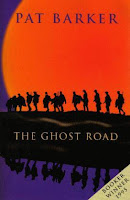
The Ghost Road - Pat Barker
It's evening now, and everybody's scribbling away, telling people the news, or as much of the news as we're allowed to tell them. I look up and down the dormitory and there's hardly a sound except for pages being turned, and here and there a pen scratching. It's like this every evening. And not just letters either. Diaries. Poems. At least two would-be poets in this hut alone.Why? you have to ask yourself. I think it's a way of claiming immunity. First-person narrators can't die, so as long as we keep telling the story of our own lives we're safe. Ha bloody fucking Ha.
This final book in the Regeneration Trilogy is the most powerful. It is no wonder it was a Booker winner. An intense story about humans and war-all told in a most unusual way. Barker writes in a very clear, easily understandable style, yet she conveys intense feelings and thoughtful observations. Most of the characters are based on historical figures which she has brought to life in a convincing manner.
We may think we know the horrors of war, but after reading Barker it becomes personal on a very human scale. Her book is less about the war than about the myriad of effects, all negative, it has on everyone involved, both directly and indirectly. There many levels of experience in these books- soldiers, girlfriends, wives, patients, nurses, doctors, lovers, friends, etc. The bondscreated and enhanced by the war and displayed in their intensity.
Wednesday, August 20, 2008
Night Train to Lisbon - Pascal Mercier
When we talk about ourselves, about others, or simply about things, we want--it could be said--to reveal ourselves in our words: We want to show what we think and feel. We let others have a glimpse into our soul. In this understanding of the case, we're the sovereign director, the self-appointed dramaturge as far as opening ourselves is concerned. But maybe this is absolutely false? A self-deception? For not only do we reveal ourselves with our words, we also betray ourselves. We give away a lot more than what we wanted to reveal, and sometimes it's the exact opposite. And the others can interpret our words as symptoms for something we ourselves may not even know. As symptoms of being us. The quote above displays what I didn't like about this book. It is from a book within the novel written by a hero of the author. If you are like me, it is either a poor translation, or it actually says very little. Mercier is a philosophy professor and this novel spends way too much time on circular mental gymnastics with little meaning to life. Maybe if you are looking for a way to experience more melancholy, which the author admires, this book would work for you.
This is another case of me being drawn to read a book by its jacket (As Dylan sang "When will they ever learn?"). The rave reviews said things like "the best book of the last ten years" (does that reviewer really read books?) "incomparable talent" (To what, philosophy professors?)
The story in this novel has an interesting premise and the author has some unusual characters. I was not, however, enraptured by the deep philosophical ramblings that are the main focus of the book. That is in spite of my typical enjoyment of ideas.
Friday, August 15, 2008
Flaubert's Parrot - Julian Barnes
I don't care much for coincidences. There's something spooky about them: you sense momentarily what it must be like to live in an ordered, God-run universe, with Himself looking over your shoulder ad helpfully dropping coarse hints about a cosmic plan. I prefer to feel that things are chaotic, free-wheeling, permanently as well as temporarily crazy--to feel the certainty of human ignorance, brutality and folly. 'Whatever else happens,' Flaubert wrote when the Franco-Prussian war broke out, 'we shall remain stupid.' Mere boastful pessimism" Or a necessary razing of expectation before anything can be properly thought, or done, or written?A collage of writing styles and ideas related to Flaubert make this a most interesting and enjoyable novel. Barnes is an excellant writer who shows off his abilities in this book. Centered loosely around a mystery with a parrot, it is mostly wild thoughts and ideas presented by an amateur Flaubert scholar. The book is filled with sharp wit and sarcasm. It is both funny and thought-provoking. Each chapter takes the reader on an entirely new adventure that may seem to have little relationship with the surrounding chapters. But that is not a negative and keeps this book moving along whenever it starts to dive too deeply into details.
I will read more of Barnes because of his intelligence, writing ability, and largely for his fresh and fun ideas. He is a writer who really lets you feel you are with him as you read his words. Now I must go read some Flaubert.
Tuesday, August 12, 2008
Pontoon - Garrison Keillor
Evelyn was an insomniac so when they say she died in her sleep, you have to question that. Probably she was sitting propped up in bed reading and heard the brush of wings and smelled the cold clean air and the angel appeared like a deer in the bedroom and Evelyn said, "Not yet. I have to finish this book."Once again Keillor takes us to Lake Wobegon and once again leaves the reader smiling with a more cheerful mood. I always hesitate to read a new Keillor book thinking I may have tired of his not dissimilar stories. But then it seems I never tire of good humor told with a good style. Just like you can watch a funny comedian do the same bit over and over, Keillor's ongoing tales of Lake Wobegon never fail to make me smile and even laugh out loud at times. Great summer reading.
Sunday, August 10, 2008
Photocopies - John Berger
A crowd. So large that one can't imagine it, even when one is part of it. A crowd in which all that the past has left is bursting out, searching, cheating, acheiving, hoping, waiting, despairing, for a future.The crowd is there because of the market. Getting richer. Getting poorer with the hope of getting a fraction richer later. The market has nothing to do with the wealthy. Here a voice and a glance of the eyes can still make a difference. Everything glistens because it may be a bargain. Everything sold is a little gain because it has been sold.
Friday, August 1, 2008
V - Thomas Pynchon
As spread thighs are to the libertine, flights of migratory birds to the ornithologist, the working part of his tool bit to the production machinist, so was the letter V to young Stencil. He would dream perhaps once a week that it had all been a dream, and that now he'd awakened to discover the pursuit of V. was merely a scholarly quest after all, an adventure of the mind, in the tradition of "The Golden Bough" or "The White Goddess".The first of Pynchon's novels launched him into the literary spotlight. Many call this a precursor to his most-acclaimed novel- Gravity's Rainbow. This is my first reading of Pynchon and the book is quite dazzling. The writing reminds me of a blend of Kerouac with its fast pace and irreverance and Joyce with his mastery of language and style. The novel is vast and dense. The reader is challenged by characters too numerous to count, wild scenes, and exotic locations. Still, Pynchon is able to pull together this menagerie into a compelling and smart novel.
Great writers are always a pleasure, albeit a challenging one at times, to read. Pynchon belongs on the list of great writers. Nearly every page of this book had phrases, sentences, or entire paragraphs that caused me to pause and read again to savor.
Tuesday, July 29, 2008
Books - Larry McMurtry
Here I am, thirty-four chapters into a book that I hope will interest the general or common reader --and yet why should these readers be interested in the fact that in 1958 or so I paid Ted Brown $7.50 for a nice copy of The Anatomy of Melancholy? How many are going to care that I visited the great Seven Gables Bookshop, or dealt with the wily L.A. dealer Max Hunley, who little store at the corner of Rodeo Drive and Little Santa Monica in Beverly Hills is now a yogurt shop....A fair answer would be that few readers are engaged by this kind of stuff, unless the writer can somehow tap deeper sentiments.