I was born twice: first, as a baby girl, on a remarkably smogless Detroit day in January of 1960; and then again, as a teenage boy, in an emergency room near Petoskey, Michigan, in August of 1974. Specialized readers may have come across me in Dr. Peter Luce's study, "Gender Identity in -Alpha-Reductase Pseudohermaphrodites," published in the Journal of Pediatric Endocrinology in 1975. Or maybe you've seen my photograph in chapter sixteen of the now sadly outdated Genetics and Heredity. That's me on page 78, standing naked beside a height chart with a black box covering my eyes.
Friday, November 27, 2009
Middlesex - Jeffrey Eugenides
I was born twice: first, as a baby girl, on a remarkably smogless Detroit day in January of 1960; and then again, as a teenage boy, in an emergency room near Petoskey, Michigan, in August of 1974. Specialized readers may have come across me in Dr. Peter Luce's study, "Gender Identity in -Alpha-Reductase Pseudohermaphrodites," published in the Journal of Pediatric Endocrinology in 1975. Or maybe you've seen my photograph in chapter sixteen of the now sadly outdated Genetics and Heredity. That's me on page 78, standing naked beside a height chart with a black box covering my eyes.Tuesday, November 17, 2009
Unholy Business - Nina Burleigh
People tell two versions of how Moussaieff made his billions, with a twist depending on whether the teller likes or dislikes the old man. The nice version is that for four decades he sold pricey jewelry to oil sheiks from a tiny shop on the ground floor of London's glittery Hilton Hotel, and also knew the prostitutes they employed. The sheiks paid the girls in jewelry because they deemed it more honorable to give their "girlfriends" presents than to pay them hard cash. After these transactions, the unsentimental ladies rode the mirrored and gilt elevators downstairs and sold the jewelry back to Moussaieff, at prices far lower than what the sheiks had paid. Then Moussaieff sold the pieces again at full value. The nastier version of the story, told by men who think the old man has crossed them, is that the jeweler sold the sheiks precious jewelry and then the escorts stole the baubles and brought them back to the shop.This is a fascinating book that enlightens the reader about antiquities dealing in the Middle East. It reads like a good mystery as it uncovers the tale of master counterfeiters. The world of antiquity traders, collectors, seekers, archaeologists, and others associated with this little known subculture is detailed as a tale of intrigue is told. The author does a nice job of balancing facts from her research with a story line.
Monday, November 16, 2009
From the Other Side of Night - Francisco X. Alarcon

Saturday, November 7, 2009
Salmonella Men on Planet Porno - Yasutaka Tsutsui
"Ludricrous! What species has no agression?!" Mogamigawa ranted, parading his basi knowledge of ethology. "If they lose their aggression they will also lose relationships between individuals. If relationships between individuals disappear, they won't even be able to reproduce. The same is tru for humans, after all.""Ah, but this planet is special in that respect," I countered. "I believe the aggressive impulse is incorporated in the erotic here. Think about it. Animals often bite each other's necks when couplating, or chase or grapple with each other in foreplay, don't they. In other words, they do things that, at first sight, seem like aggression when mating. So wouldn't you agree it's impossible to make a clear distinction between the two impulses? And for animals on this planet, the erotic is amplified, since there's no need to show aggression, either to heterogeneous or to homogeneous individuals. So they try to mate with individuals of both types."
This collection of short stories displays the author's wild, humorous, and imaginative mind. The stories read like humorous versions of Twilight Zone shows. The characters are often in seemingly frightful situations, but they are detached and aware of situations too bizarre to be real. The author is a Japanese science-fiction writer and that is evident in these stories. Most are not science-fiction, but strange what-if scenarios. Very well composed and enjoyable to read. I was looking for something light and different after reading too many dark, heavy books and this book was that.
The author's sci-fi background is most evident in the title story, which is also the longest in the book. Like many stories in this collection, it has light-hearted takes on sexuality. On Planet Porno, we see an ecology based around sex rather than survival of the fittest. The world is too fantastic to have any sense of reality, but never-the-less has a premise that is not altogether implausible.
Tuesday, November 3, 2009
Water - Bapsi Sidhwa
Bhagya sat cross-legged on the kitchen floor, grinding rice with a mortar and pestle and adding it to the flour she stored in a brass jar. Dusk had thickened into night outside the kitchen window, and the hectic twittering of the birds had given way to the muted sounds of nocturnal animals of the forest and the sudden orchestration of cicadas. Her day's choirs done, her family fed, this was Bhagya's hour of solitude. The rhythmic pounding of the pestle and her automated movements had a meditative quality, and she often chanted or hummed holy passages from the Bhagvad Gita or the Mahabharata at this time.This is the first time I have read a book based on a movie. The book is very good, while I hear the movie is excellent. This is gut-wrenching tale that is still able to find humor and hope in unimaginable circumstances. I liked the pacing of the writing- easy to read, yet dense with emotions. This is another book that supports a world wide revolution to bring justice for the women of the world. You will find yourself saying "Oh no, this isn't really happening to this poor innocent child."
In spite of the horrible and indefensible religious oppression of the Hindu women in the book, the hope of youth keeps this book from becoming too depressing. It is fascinating reading about Indian culture and places that have not changed in a millennium. The book is quite an experience and leaves a strong impact on the reader.
Tuesday, October 27, 2009
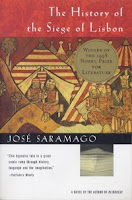
The History of the Siege of Lisbon - Jose Saramago
It is time that we should know the person about whom we have been talking indiscreetly, if name and surnames could ever add anything useful to the normal identifying features and other statistics, age, height, weight, morphological type, skin tone, colour of eyes, whether the hair is smooth, curly, or wavy, or has simply disappeared, timbre of voice, clear or harsh, weight, characteristic gestures, manner of walking, since experience of human relationships has shown that, once apprised of these details and sometimes many more, not even this information serves any purpose, nor are we capable of imagining what might be missing.This book is a challenge to read and only worth the effort if you are a student of literature. The style includes extremely long sentences and paragraphs. For example, the book starts out with a one sentence paragraph which covers six pages. I counted seventy-one commas in another sentence which was just one page long. The translator says the stream of thought style provides a stronger sense of interaction and diverse interpretation. The diversity in interpretation perhaps comes from not remembering where a sentence began or what subject is being presented.
I wanted to like this book. It has a great premise: a proofreader alters history by changing a work in an author's manuscript and falls in love with an editor. Interspersed is a tale inserted into a historical time reinterpreting the Seige of Lisbon against the Moors. The author is a great thinker as well as a writer and there are brilliant thoughts and phrases in this book. For me, however, it is far too complicated to read and meanders off into too many uninteresting tangents.
Wednesday, October 21, 2009
The Rings of Saturn - W.G. Sebald
For days and weeks on end one racks one's brains to no avail, and, if asked, one could not say whether one goes on writing purely out of habit, or a craving for admiration, or because one knows not how to do anything other, or out of sheer wonderment, despair or outrage, any more than one could say whether writing renders one more perceptive or more insane. Perhaps we all lose our sense of reality to the precise degree to which we are engrossed in our own work, and perhaps that is why we see in the increasing complexity of our mental constructs a means for greater understanding, even while intuitively we know that we shall be able to fathom the imponderables that govern our course through life. Sebald has crafted an intelligent, well-written book. This is a first person account of travels on England's Northeastern coast. Towns with profitable pasts during expansive industrial times are visited. They are mostly skeletons of cities now. The author uses the town histories to launch into tales about prior residents or the history that helped define the town in its prime. The digressions are often quirky and help contribute an overall feeling of other worldliness in this book. To enjoy this book, the reader must let his mind wander and enjoy details left out of history books. As someone who grew up reading encyclopedias, I loved it.
The author is superb at finding details to support a melancholic meander through a place time left behind. He leaves the reader pondering empires, wars, economic progress, rapid changes, and simple lives in forgotten places. A good book for a slow read.
Sunday, October 11, 2009
Little People in the City - Slinkachu
The photographic traces collected in this book, capturing the evanescent existence of the diminutive in the great and troubling city, have all the power of "Gulliver's Travels" to impose upon us a realization of the asinine pride we take in the mere fact of comparison. Or rather: the asinine pride that derives from our environment and ourselves being to scale with each other. The built environment is an outgrowth of social form--Schelling's 'frozen music'--and thus an endlessly repeated sample of the same old tune: human domination and submission, leading to individual alienation. Saturday, October 10, 2009
Death Comes for the Archbishop - Willa Cather
Tuesday, October 6, 2009
The Plague - Albert Camus
Without memories, without hope, they lived for the moment only. Indeed, the here and now had come to mean everything to them. For there is no denying that the plague had gradually killed off in all of us the faculty not of love only but even of friendship. Naturally enough, since love asks something of the future, and nothing was left us but a series of present moments....
They knew now that if there is one thing one can always yearn for and sometimes attain, it is human love. But for those others who aspired beyond and above the human individual toward something they could not even imagine, there had been no answer.
A great piece of literature which reads as well today, and possibly better, as when it was written sixty years ago. A plague enters a North African town in modern times resulting in its quarantine from the rest of the world. The people and the town are stripped of normal routines and relationships as death and isolation take their tolls.
Tuesday, September 29, 2009
Einstein's Dreams - Alan Lightman
There is a place where time stands still. Raindrops hang motionless in air. Pendulums of clocks float mid-swing. Dogs raise their muzzles in silent howls. Pedestrians are frozen on the dusty streets, their legs cocked as if held by strings. The aromas of dates, mangoes, coriander, cumin are suspended in space.Tuesday, September 8, 2009
As They See 'Em -- Bruce Weber
For some reason, "horseshit" is specifically a baseball term, having been the most popular and utilitarian curse word in the game for generations, as familiar a locution at the ballpark as "strike three".
...At one game I attended, Alex Rodriquez, the Yankees celebrity third baseman, sauntered over to Bruce Fromming and gave him an unsolicited compliment, something about how much he appreciated all of Fromming's years of professionalism...when I asked Rodriquez about it the next day, he shrugged. He said Fromming, the longest serving umpire, deserved it. "After all, all we do is tell them they're horseshit," Rodriquez said.
Skip this book if you don't love baseball. Even if you do love baseball, this book will only satisfy avid fans who find umpiring interesting. As an avid fan, I liked parts of this book and learned quite a lot about umpiring. The book, however, is too long and would benefit from from serious editing. A few stories by old umpires are interesting, but the last half of this book seems to be nothing but story after story.
Dali & I - Stan Lauryssens
Wednesday, August 26, 2009
A Mad Desire to Dance - Elie Wiesel
She has dark eyes and the smile of a frightened child. I searched for her all my life. Was it she who saved me from the silent death that characterizes resignation to solitude? And from madness in its terminal phase, terminal as we refer to cancer when incurable? Yes, the kind of madness in which one can find refuge, if not salvation? Friday, July 24, 2009
The Pleasures and Sorrows of Work - Alain de Botton

I loved this book. The author takes an in depth look at some ordinary, and yet eccentric jobs--electric power line engineer, cookie maker, motivational speaker, commercial fisherman, and more. Each chapter elaborates the fine points of the job as well as examines the interactions between humans and the work we do. The author writes in a very readable and engaging style while making the reader constantly evaluate how we live on planet earth.
We see both pleasures and sorrows in the working world. Mostly, the reader is left to question how it is we got into the predicament where our working life can be so separated from nature and human needs. The author provides interesting insights into the unusual aspects of many jobs while illuminating the extreme disconnection many experience in the corporation dominated world of today. I highly recommend this book.
The Invention of Air - Steven Johnson
So this is a history book about the Enlightenment and the American Revolution that travels from the carbon cycle of the planet itself, to the chemistry of gunpowder, to the emergence of the coffeehouse in European culture, to the emotional dynamics of two friends compelled by history to betray each other.This is an entertaining book about Joseph Priestly, a scientist who made some great discoveries in the late 1700s. He was also a great intellectual who contributed to a variety of discussions with famous people including Thomas Jefferson and Benjamin Franklin. Priestly was a free thinker who opposed religious fundamentalism and supported the French revolution. That got him in trouble in Britain and he immigrated to the US seeking more freedom to continue his scientific work. That work included discovering that plants create oxygen.
The book is well written with the author displaying his own opinions on the development of science and intellectual thought. For example, he praises the benefits of early coffee shops where thoughtful people could discuss ideas at length. Priestly's life is fascinating and if this book didn't get a little bogged down with details in the last half, I would have given it my highest rating.
Letters from A to X - John Berger
I wanted to put my hand on a letter and draw its outline to send you. Sometime after - whenever it was - I came across a book which explained how to draw hands and I opened it, turning page after page. And I decided to buy it. It was like the story of our life. All stories are also the stories of hands - picking up, balancing, pointing, joining, kneading, threading, caressing, abandoned in sleep, cutting, eating, wiping, playing music, scratching, grasping, peeling, clenching, pulling a trigger, folding. On each page of the book there are careful drawings of hands performing a different action. So I'm going to copy one. Negotiating with the Dead - Margaret Atwood
Writing, Writers, The Writing Life - if this last is not an oxymoron. Is the subject like the many-headed Hydra, which grows tow other subtexts as soon as you demolish one? Or is it more like Jacob's nameless angel, with whom you must wrestle until he blesses you? Or is it like Proteus, who must be firmly grasped through all his changes? Hard to get hold of, certainly. Where to start? At the end called Writing, or the end called The Writer? With the gerund or the noun, the activity or the one performing it? And where exactly does one stop and the other begin?Rouse Up, O Young Men of the New Age - Kenzaburo Oe

Sunday, May 31, 2009
Conversations with Professor Y - Louis-Ferdinand Celine
Wednesday, April 8, 2009
Madame Bovary - Gustave Flaubert
Before the wedding, she has believed herself in love. But not having obtained the happiness that should have resulted from that love, she now fancied that she must have been mistaken. And Emma wondered exactly what was meant in life by the words 'bliss', 'passion', 'ecstasy', which had looked so beautiful in books.A Quiet Life - Kenzaburo Oe

This all happened the year Father was invited to be a writer-in-residence at a university in California, and circumstances required that Mother accompany him. One evening, as their departure drew near, we gathered around the family table and had our meal in an atmosphere slightly more ceremonious than usual. Even on occasions like this, Father is incapable of discussing anything important concerning the family without weaving in some levity. I had just come of age, at twenty, and he started talking about my marriage plans as if they were a topic for light discussion.
Oe is a Nobel Laureate from Japan. He bases this story on a family separated by the parents extended stay in California. The daugher and a mentally challenged son remain in Japan. The daughter must define family as she takes on care-giving for her brother.
I enjoyed the slow pacing and style employed by the author. It is told in the first person from the daughter's point of view. Simple, and yet complicated, situations arise to take the reader into the unique lives of this family. Much of what happens takes place in the minds of the characters, especially the daughter. The style is gentle and thoughtful. I was very drawn into this book. In a very unassuming manner, it examines relationships. Most intriguing is the mentally handicapped son with musical skills of a genius.
Tuesday, February 24, 2009
Paris, Eugene Atget - Andreas Krase
Eugene Atget is "the" photographer of Old Paris. Between 1897 and 1927 he recorded the imprint of history as no other photograher has done. Daily tracing the changes in the face of the city was not only his profession, but also his vocation. When he was laid to rest in 1927, his funeral went virtually unnoticed, yet today Atget is regarded as one of the most important photographers of all time.Atget's pictures of Paris are evocative a time that has largely passed in Paris. Of course, the charm of Paris is how much remains of its past. Atget documented the city while creating fabulous pictures that demand attention in simple ways. His photos encompass the Paris not popular with tourists. He doesn't shoot pictures of crowds or big events. His photos favor empty streets and alleys more than people. Great artistry documenting the most ordinary of a totally unordinary city.
Tuesday, February 17, 2009
No Beginning. No End. - Jakusho Kwong
When the sun first comes up and shines on you, he said, your shadow is big behind you. But as you continue to sit, your shadow gets smaller and smaller, until finally it's just Buddha sitting there.109 East Palace - Jennet Conant
In the days that followed, she learned that the man she had met, who went by the name of Mr. Bradley, was actually J. Robert Oppenheimer, a famous American physicist from the University of California at Berkeley and the leader of a secret wartime project. Bradley was the name he would use in and around town, and the way she was to address him in public. She would learn never to mention his real name and, for that matter, never to mention him at all. Not to anyone. She was told never, under any circumstances, to use the word "physicist." "I was told never to ask questions, never to have a name repeated," she wrote, recalling her initiation into the most momentous scientific project of the twentieth century.Saturday, January 10, 2009
The Enchantress of Florence - Salman Rushdie
Peacocks danced on the morning stones of Sikri and in the distance the great lake shimmered like a ghost. The emperor's gaze traveled past the peacocks and the lake, past the court of Herat and the lands of the fierce Turk, and rested on the spires and domes of an Italian city far away. "Imagine a pair of women's lips," Mogor whispered, "puckering for a kiss. That city of Florence, narrow at the edges, swelling at the center, with the Arno flowing through between, parting the two lips, the upper and the lower. The city is an enchantress. When it kisses you, you are lost, whether you be commoner or king."
Rushdie has concocted a convoluted fantasy with wild stories and exotic characters. East meets west in this book based in part on historical research. It is both engaging and confusing--an intriguing fairy tale which leaves the reader guessing about what really happening. At times I was in love with this book and at other times I found it tedious. The author can write dazzling lines and create imaginative situations that are a joy to read. For that reason, I did enjoy reading this Booker Award winning novel. I wish Rushdie didn't meander so much in some details and side adventures. Yes, he can write beautifully, sometimes it felt like he was doing so just to prove it. All in all, worth reading if you can commit to a challenging read and want to savor some excellent writing and inventive storytelling.
Sunday, January 4, 2009
Pirates - Angus Konstam
This book sets out to examine real pirates throughout history, from the ancient Mediterranean to the waters of the Caribbean, and from the eastern seaboard of America to the South China Sea. Stripped of romanticism, their crimes and their fates are detailed, and the reality revealed.With the recent piracy situation in Somalia, I decided to revisit the issue and found this book at the library. It is a good history of piracy from its earliest known beginnings up to the current situations in places like Somalia.
The book is full of good pictures which add greatly to its ability to provide insight into piracy. For example, the types of ships favored by pirates are well-portrayed and give the reader a clear understanding of outmaneuvering a larger ship. I learned a great deal from reading this book. When I took history many years ago in school, Sir Francis Drake was not described as a pirate, which he certainly was, but as a great explorer. This is but one of many fascinating tales in Pirates.
The book does a nice job of describing how and why pirates flourish at different times and in the different places. It also covers the ongoing battles to protect ships and cargo from pirates throughout the ages. This is a good book to fill in what you don't know about pirates and clear up misconceptions you have probably acquired.
Monday, December 22, 2008
Total Immersion - Glenna Luschei
Cowgirl StampedeThough I fly in from California where words crest
high as the Big Sur Coast, I want to write an epic vast
as Texas, horns grand as the long-horned cattle
that cowgirls drove across the West to Ft. Worth
I want to grapple with those poems that stampede me
all my life, heave them to the ground, bellow to our sisters
that our lives are worth the long trek across the plains
to Abilene. I want to hogtie those poems.
while the cowhands cheer and wave their Stetsons.
jump to their feet in a boot-scooting swing. I'll forge
shit-kicking poems that will fill up a ball room, make my
people dance all night, belt buckle to belt buckle.
I had the pleasure of hearing Glenna at a recent poetry event and fell in love with her poetry. This book is an excellent collection of recent poems. Her poetry is clean and pure as it describes both simple and complex situations. A light-heartedness mixed with deep compassion makes the poems touch the reader in a very personal way. Glenna has travelled widely to both exotic and seemingly ordinary places. With the poet's mind, she is able to extract the ordinary in the exotic and the exotic in the ordinary. These poems don't bemoan what's missing in life, but rather extol the wonders of passing through life. The poems are like pictures of what someone may have missed--but not Glenna.
Tuesday, December 16, 2008
The Gathering - Anne Enright
All big families are the same. I meet them sometimes at parties or in pubs, we announce ourselves and then we grieve-Billy in Boston, and Jimmy-Joe in Jo'burg, doing well-the dead first, then the lost, and then the mad.There is always a drunk. There is always someone who has been interfered with, as a child. There is always a colossal success, with several houses in various countries to which no one is ever invited. There is a mysterious sister. These are just trends, of course, and, late at night, everything makes sense. We pity our mothers, what they had to put up with in bed or in the kitchen, and we hate them or we worship them, but we always cry for them- at least I do. The imponderable pain of my mother, against which I have hardened my heart. Just one glass over the odds and I will thump the table, like the rest of them, and howl for her too.
This is a thought-provoking, emotional journey through a family shaken by a death. Enright, in the tradition of great Irish writers, delves into places left uncovered by most people, including most writers. This book is well-deserving of the Booker Prize which it was awarded.
I liked how Enright, focusing primarily on a female sibling in a large family, leads a surreal experience following the death. She notes inter-generational relationships and how those too are somewhat surreal. Everything is new after a death, but everything old surfaces.
Thursday, December 11, 2008
In Our Hearts We Were Giants - Yehuda Koren & Eilat Negev
With our legs we measure the long and, for the Lilliputs, arduous distance from their barrack to Mengele's clinic; with our eyes we assess the height of the electrified barbed wire fence and the watchtowers. We slide into the deep, muddy ditches that were dug to separate the camp's sections. It's amazing the extent of the security precautions that were taken by the Nazis against people so helpless and feeble. We see it all, and understand nothing.An amazing story told by two reporters who researched this most unusual family with seven dwarfs. They are all siblings who inherited a dominant gene leading to a type of dwarfism. With little else to do as a physically handicapped, they became an accomplished travelling entertainment troupe.
The authors thoroughly document the entire family's saga from thier childhood to their internment as Jews in Auschwitz as well as life after the war. The book discusses dwarfism and the unique challenges of little people. The reader learns how this one family is able to survive the unimaginable horrors of the Nazis. Much of the book covers the time period in the concentration camp under treatment with the monster, Dr. Mengele. Reading this book moved me to tears of sadness at the inhumanity and smiles of wonder at family bonds, love, and perservance.