"But my least favorite author in all the world--how could I have forgotten? Henry James. I hate Henry James more than tongue can tell. I have read everything he wrote, sometimes more than once. I think he's the worst writer in the English language. Those endless sentences. I always pick up Henry James and I think, Oooh! This is wonderful! And then I will hear a little sound. And it's the plug being pulled. And the whole thing is going down the drain like the bathwater."
Sunday, February 28, 2010
Ascending Peculiarity - Karen Wilken
"But my least favorite author in all the world--how could I have forgotten? Henry James. I hate Henry James more than tongue can tell. I have read everything he wrote, sometimes more than once. I think he's the worst writer in the English language. Those endless sentences. I always pick up Henry James and I think, Oooh! This is wonderful! And then I will hear a little sound. And it's the plug being pulled. And the whole thing is going down the drain like the bathwater."Thursday, February 18, 2010
American Photobooth - Nakki Goranin
How did all of these orphaned photos come into my life? For twenty-five years, I have been collecting all types of historical photos, which have influenced my time and vision in the darkroom. The past ten years or so I have focused on searching for photobooth pictures. These tiny time fragments can be found in garage sales and auctions and on the Internet. Like the forgotten images they are, it has been impossible to track down the original owners or their families. Traded, packed in old scrapbooks, outliving the smiling faces, all these photographs have finally found a home in this book.Tuesday, February 9, 2010
Michelangelo and the Pope's Ceiling - Ross King
Fresco painting called for numerous preparatory stages, but among the most vital and indispensable were the drawings by which designs were worked out and then transferred to the wall. Before a single stroke of paint could be applied to the vault of the Sistine Chapel, Michelangelo needed to produce hundreds of sketches to establish both the intricate body language of the characters and the overall composition of the various scenes. The poses for many of his figures, including the dispositions of their hands and expressions on their faces, were composed through six or seven separate studies, which means he may have executed over 1,000 drawings in the course of his work on the fresco. These ranged from tiny scribbles--thumbnail sketches called primo pensieri, or "first thoughts"--to dozens of highly detailed, larger-than-life cartoons. This book details more than one of history's greatest artistic accomplishments, the ceiling of the Sistine Chapel, it also encompasses the historical times, the politics of the day, the state of the church, the art of fresco painting, and, of course, Michelangelo's life and artistic challenges. It is a fascinating tale which reads like a novel. The book often reads more like a history book than one about art, however, the historical events of the day are both intriguing and intertwined with Michelangelo's work.
Wednesday, February 3, 2010
Bicycle Diaries - David Byrne
This point of view--faster than a walk, slower than a train, often slightly higher than a person--became my panoramic window on much of the world over the last thirty years--and it still is. It's a big window and it looks out on a mainly urban landscape. (I'm not a racer or sports cyclist.) Through this window I catch glimpses of the mind of my fellow man, as expressed in the cities he lives in. Cities, it occurred to me, are physical manifestations of our deepest beliefs and our unconscious thoughts, not so much as individuals, but as the social animals we are. A cognitive scientist need only look at what we have made--the hives we have created--to know what we think and what we believe to be important, as well as how we structure those thoughts and beliefs. It's all there, in plain view, right out in the open; you don't need CAT scans and cultural anthropologists to show you what's going on inside the human mind; its inner workings are manifested in three dimensions, all around us. Our values an hopes are sometimes embarrassingly easy to read. They're right there--in the storefronts, museums, temples, shops, and office buildings and in how these structures interrelate, or sometimes don't. They say, in their unique visual language, "This is what we think matters, this is how we live and how we play."David Byrne, made famous by his group the Talking Heads, has been riding a bicycle in cities around the world since the 1970s. He travels with a folding bike as part of his luggage. This book is based on his observations and thoughts derived from his bicycling experiences.
The book begins with a description of the pleasures and advantages of bike riding as opposed to other forms of transportation. Byrne is a keen observer of cities, especially their infastructure. The writing often diverges into art, politics, and other interests of Byrne. Much of this is thoughtful and insightful, although a long way from bicycle observations. I had expected the book to be much more focused on bicycle experiences. It is largely a diary with the bicycle providing an entre into thoughts and people in particular cities. Still, this is an enjoyable read which I recommend. If you already like David Byrne, you should definitely read this book.
Tuesday, February 2, 2010
Angel's World - Michael Lesy
By photographing himself, Rizzuto affirmed his own presence; by photographing the suffering of others as well as by recording the awesome shape of a man-made world, Rizzuto used his camera to lessen the pain of loneliness and to transcend his fear and anger. He used his camera to confirm himself, to enter and discover the world, and then to rise above it. His loneliness, his persistent vision, and his transcendence are what he shares with all photographers who have embarked on solitary quests that have transformed and restored them to themselves.Wednesday, January 27, 2010
Into the Beautiful North - Luis Alberto Urrea
Before them, a vast smear of smoke. Not smoke. Birds. Aloft. Suddenly, as one, they turned, vanishing in the air like the louvers of God's own opening window blinds. Appeared. Vanished. Appeared. Swept away to stubbled fields. They clattered to a stop in Topeka. They felt like they had sandpaper in their shorts, old glue in their mouths.
Friday, January 22, 2010
The Power and The Glory - Graham Greene
The mule suddenly sat down under the priest. It was not an unnatural thing to do, for they had been travelling through the forest for nearly twelve hours. They had been going west, but news of soldiers met them there and they had turned east; the Red Shirts were active in that direction, so they had tacked north, wading through the swamps, diving into the mahogany darkness. Now they were both tired out and the mule simply sat down. The priest scrambled off and began to laugh. He was feeling happy. It is one of the strange discoveries a man can make that life, however you lead it, contains moments of exhilaration; there are always comparisons which can be made with worse times: even in danger and misery the pendulum swings.Friday, January 15, 2010
The History of Love - Nicole Krauss
When they write my obituary. Tomorrow. Or the next day. It will say, LEO GURSKY IS SURVIVED BY AN APARTMENT FULL OF SHIT. I'm surprised I haven't been buried alive. The place isn't big. I have to struggle to keep a path clear between bed and toilet, toilet and kitchen table, kitchen table and front door. If I want to get from the toilet to the front door, impossible, I have to go by way of the kitchen table. I like to imagine the bed as home plate, the toilet as first base, the kitchen table as second, the front door as third: should the doorbell ring while I am lying in bed, I have to round the toilet and the kitchen table in order to arrive at the door. If it happens to be Bruno, I let him in without a word and then jog back to bed, the roar of the invisible crowd ringing in my ears. I often wonder who will be the last person to see me alive. If I had to bet, I'd bet on the delivery boy from the Chinese take-out. I order in four nights out of seven.
I seem to be on a roll with good books and this one certainly deserves my highest rating. Krauss writes a very creative story which gives the reader a satisfying and enriching experience. Her style is refreshing and contemporary. It is imaginative and fresh from beginning to end while remaining driven by the story and characters.
Tuesday, January 5, 2010
Dreams of My Russian Summers - Andrei Makine
I also knew that I should do my very best not to talk about books. And that we would talk about them all the same, a great deal, often till late at night. For the France that had appeared one day in the middle of the steppes of Saranze owed its birth to books. It was indeed essentially a bookish country, a country of composed of words, whose rivers flowed like the lines of verse, whose women wept in alexandrines and whose men quarreled in broadsides. That was how we discovered France as children, through its literary life, its verbal substance, shaped into a sonnet and honed by an author. Our family mythology attested that a little volume with a battered cover and a tarnished gilt top traveled with Charlotte on all her journeys. As the last link with France. Or perhaps as the constant possibility of magic....We confused France with her literature. And true literature was that magic, a word, a verse, a chapter of which transported us into a changeless moment of beauty.A lush, poetic book which is a true pleasure to read. Each paragraph is crafted like a poem, each chapter like a book unto itself. The author beautifully contrasts France, where his grandmother grew up, and Russia where the author and she lived most her life. While it is easy for anyone to reflect on the stark contrasts between a remote Russian village and Paris, it is difficult to imagine a writer doing it so deeply and thoughtfully. He contrasts the inner experiences of the two places that makes the reader pause to let the experience reverberate inside.
Flight - Sherman Alexie
I take careful aim. Then I laugh. This journey started when I shot a bunch of strangers in a bank. A horrible, evil act. And now I'm lying in the dirt, getting ready to shoot a bunch of strangers. This time in self-defense and in defense of the two boy who are riding farther and farther away from me. Tuesday, December 29, 2009
The Return of the Caravels - Antonio Lobo Antunes
The poet pictured a horde of consumptives in hospital uniforms, crouching in the mist of the dunes, waiting for a laughable monarch who would rise up out of the waters accompanied by his defeated army. Ever since he'd returned from Africa, even the flow of time had seemed absurd to him, and he still hadn't got used to the slow quince-jelly sunsets, the lack of grass with its avid insect rustle, and he would move about the city as if on a planet created by the mechanics of imagination, keeping informed through items in the newspapers that were as enigmatic as the singing of whales. Antunes has written an extremely complex, perhaps a little too much so, book that encompasses an expanse of Portuguese history. The book is surreal as it juxtaposes historical figure with modern times. Here we find the explorer's sailing caravels docked with modern oil tankers in the 1970s as a former African colony fails into chaos. Combine the melding of different times with long sentences abounding with descriptive metaphors and you have a book that will challenge the reader. Additionally, this is an author who loves to includes disgusting descriptions of biological fluids expelled from every imaginable source. As I began each chapter, I started wondering how many pages it would take to find the word "vomit" again.
Tuesday, December 22, 2009
Pilgrims - Garrison Keillor
The first pilgrims through the International Arrivals portal at Leonardo da Vinci was Margie Krebsbach, face scrubbed, fresh, grinning, towing her husband Carl who looked stunned as if struck by a ball-peen hammer, and then the others came slouching an shuffling along, jet-lagged, brain-dead, and right away she spotted the thin, spiky-haired man in the blue blazer holding up the sign--LAKE WOBEGON--in one hand, high, and she let out a whoop and let go of Carl. "This is so neat!" she said, meaning the sign--the words "Lake Wogegon"--here!--in Italy!--Great God! Disappointing! Hard to say when I love listening to Keillor and have enjoyed other writings by him. I was disappointed that the trip to Italy by a group from Wobegon included so little about Italy. Mostly, the book set up situations for the characters to tell stories about Wobegon days. I wondered why it didn't just occur during a family picnic with rounds of story telling. This may have worked better as a collection of short stories. As a novel, it didn't work for me. The story never seems to gain any traction to move forward and I found myself reading just to get to the end.
Wednesday, December 16, 2009
Giovanni's Room - James Baldwin
I long to be again among all those foolish people, running for metros and jumping off of buses and dodging motorcycles and having traffic jams and admiring all that crazy statuary in all those absurd parks. I weep for the fishy ladies in the Place de la Concorde. Spain is not at all like that. Whatever else Spain is, it is not frivolous. I think, that I would stay in Spain forever--if I had never been to Paris. Spain is very beautiful, stony and sunny and lonely. But by and by you get tired of olive oil and fish and castanets and tambourines--or, anyway, I do. I want to come home, to come home to Paris.Friday, November 27, 2009
Middlesex - Jeffrey Eugenides
I was born twice: first, as a baby girl, on a remarkably smogless Detroit day in January of 1960; and then again, as a teenage boy, in an emergency room near Petoskey, Michigan, in August of 1974. Specialized readers may have come across me in Dr. Peter Luce's study, "Gender Identity in -Alpha-Reductase Pseudohermaphrodites," published in the Journal of Pediatric Endocrinology in 1975. Or maybe you've seen my photograph in chapter sixteen of the now sadly outdated Genetics and Heredity. That's me on page 78, standing naked beside a height chart with a black box covering my eyes.Tuesday, November 17, 2009
Unholy Business - Nina Burleigh
People tell two versions of how Moussaieff made his billions, with a twist depending on whether the teller likes or dislikes the old man. The nice version is that for four decades he sold pricey jewelry to oil sheiks from a tiny shop on the ground floor of London's glittery Hilton Hotel, and also knew the prostitutes they employed. The sheiks paid the girls in jewelry because they deemed it more honorable to give their "girlfriends" presents than to pay them hard cash. After these transactions, the unsentimental ladies rode the mirrored and gilt elevators downstairs and sold the jewelry back to Moussaieff, at prices far lower than what the sheiks had paid. Then Moussaieff sold the pieces again at full value. The nastier version of the story, told by men who think the old man has crossed them, is that the jeweler sold the sheiks precious jewelry and then the escorts stole the baubles and brought them back to the shop.This is a fascinating book that enlightens the reader about antiquities dealing in the Middle East. It reads like a good mystery as it uncovers the tale of master counterfeiters. The world of antiquity traders, collectors, seekers, archaeologists, and others associated with this little known subculture is detailed as a tale of intrigue is told. The author does a nice job of balancing facts from her research with a story line.
Monday, November 16, 2009
From the Other Side of Night - Francisco X. Alarcon

Saturday, November 7, 2009
Salmonella Men on Planet Porno - Yasutaka Tsutsui
"Ludricrous! What species has no agression?!" Mogamigawa ranted, parading his basi knowledge of ethology. "If they lose their aggression they will also lose relationships between individuals. If relationships between individuals disappear, they won't even be able to reproduce. The same is tru for humans, after all.""Ah, but this planet is special in that respect," I countered. "I believe the aggressive impulse is incorporated in the erotic here. Think about it. Animals often bite each other's necks when couplating, or chase or grapple with each other in foreplay, don't they. In other words, they do things that, at first sight, seem like aggression when mating. So wouldn't you agree it's impossible to make a clear distinction between the two impulses? And for animals on this planet, the erotic is amplified, since there's no need to show aggression, either to heterogeneous or to homogeneous individuals. So they try to mate with individuals of both types."
This collection of short stories displays the author's wild, humorous, and imaginative mind. The stories read like humorous versions of Twilight Zone shows. The characters are often in seemingly frightful situations, but they are detached and aware of situations too bizarre to be real. The author is a Japanese science-fiction writer and that is evident in these stories. Most are not science-fiction, but strange what-if scenarios. Very well composed and enjoyable to read. I was looking for something light and different after reading too many dark, heavy books and this book was that.
The author's sci-fi background is most evident in the title story, which is also the longest in the book. Like many stories in this collection, it has light-hearted takes on sexuality. On Planet Porno, we see an ecology based around sex rather than survival of the fittest. The world is too fantastic to have any sense of reality, but never-the-less has a premise that is not altogether implausible.
Tuesday, November 3, 2009
Water - Bapsi Sidhwa
Bhagya sat cross-legged on the kitchen floor, grinding rice with a mortar and pestle and adding it to the flour she stored in a brass jar. Dusk had thickened into night outside the kitchen window, and the hectic twittering of the birds had given way to the muted sounds of nocturnal animals of the forest and the sudden orchestration of cicadas. Her day's choirs done, her family fed, this was Bhagya's hour of solitude. The rhythmic pounding of the pestle and her automated movements had a meditative quality, and she often chanted or hummed holy passages from the Bhagvad Gita or the Mahabharata at this time.This is the first time I have read a book based on a movie. The book is very good, while I hear the movie is excellent. This is gut-wrenching tale that is still able to find humor and hope in unimaginable circumstances. I liked the pacing of the writing- easy to read, yet dense with emotions. This is another book that supports a world wide revolution to bring justice for the women of the world. You will find yourself saying "Oh no, this isn't really happening to this poor innocent child."
In spite of the horrible and indefensible religious oppression of the Hindu women in the book, the hope of youth keeps this book from becoming too depressing. It is fascinating reading about Indian culture and places that have not changed in a millennium. The book is quite an experience and leaves a strong impact on the reader.
Tuesday, October 27, 2009
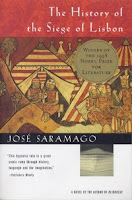
The History of the Siege of Lisbon - Jose Saramago
It is time that we should know the person about whom we have been talking indiscreetly, if name and surnames could ever add anything useful to the normal identifying features and other statistics, age, height, weight, morphological type, skin tone, colour of eyes, whether the hair is smooth, curly, or wavy, or has simply disappeared, timbre of voice, clear or harsh, weight, characteristic gestures, manner of walking, since experience of human relationships has shown that, once apprised of these details and sometimes many more, not even this information serves any purpose, nor are we capable of imagining what might be missing.This book is a challenge to read and only worth the effort if you are a student of literature. The style includes extremely long sentences and paragraphs. For example, the book starts out with a one sentence paragraph which covers six pages. I counted seventy-one commas in another sentence which was just one page long. The translator says the stream of thought style provides a stronger sense of interaction and diverse interpretation. The diversity in interpretation perhaps comes from not remembering where a sentence began or what subject is being presented.
I wanted to like this book. It has a great premise: a proofreader alters history by changing a work in an author's manuscript and falls in love with an editor. Interspersed is a tale inserted into a historical time reinterpreting the Seige of Lisbon against the Moors. The author is a great thinker as well as a writer and there are brilliant thoughts and phrases in this book. For me, however, it is far too complicated to read and meanders off into too many uninteresting tangents.
Wednesday, October 21, 2009
The Rings of Saturn - W.G. Sebald
For days and weeks on end one racks one's brains to no avail, and, if asked, one could not say whether one goes on writing purely out of habit, or a craving for admiration, or because one knows not how to do anything other, or out of sheer wonderment, despair or outrage, any more than one could say whether writing renders one more perceptive or more insane. Perhaps we all lose our sense of reality to the precise degree to which we are engrossed in our own work, and perhaps that is why we see in the increasing complexity of our mental constructs a means for greater understanding, even while intuitively we know that we shall be able to fathom the imponderables that govern our course through life. Sebald has crafted an intelligent, well-written book. This is a first person account of travels on England's Northeastern coast. Towns with profitable pasts during expansive industrial times are visited. They are mostly skeletons of cities now. The author uses the town histories to launch into tales about prior residents or the history that helped define the town in its prime. The digressions are often quirky and help contribute an overall feeling of other worldliness in this book. To enjoy this book, the reader must let his mind wander and enjoy details left out of history books. As someone who grew up reading encyclopedias, I loved it.
The author is superb at finding details to support a melancholic meander through a place time left behind. He leaves the reader pondering empires, wars, economic progress, rapid changes, and simple lives in forgotten places. A good book for a slow read.
Sunday, October 11, 2009
Little People in the City - Slinkachu
The photographic traces collected in this book, capturing the evanescent existence of the diminutive in the great and troubling city, have all the power of "Gulliver's Travels" to impose upon us a realization of the asinine pride we take in the mere fact of comparison. Or rather: the asinine pride that derives from our environment and ourselves being to scale with each other. The built environment is an outgrowth of social form--Schelling's 'frozen music'--and thus an endlessly repeated sample of the same old tune: human domination and submission, leading to individual alienation. Saturday, October 10, 2009
Death Comes for the Archbishop - Willa Cather
Tuesday, October 6, 2009
The Plague - Albert Camus
Without memories, without hope, they lived for the moment only. Indeed, the here and now had come to mean everything to them. For there is no denying that the plague had gradually killed off in all of us the faculty not of love only but even of friendship. Naturally enough, since love asks something of the future, and nothing was left us but a series of present moments....
They knew now that if there is one thing one can always yearn for and sometimes attain, it is human love. But for those others who aspired beyond and above the human individual toward something they could not even imagine, there had been no answer.
A great piece of literature which reads as well today, and possibly better, as when it was written sixty years ago. A plague enters a North African town in modern times resulting in its quarantine from the rest of the world. The people and the town are stripped of normal routines and relationships as death and isolation take their tolls.
Tuesday, September 29, 2009
Einstein's Dreams - Alan Lightman
There is a place where time stands still. Raindrops hang motionless in air. Pendulums of clocks float mid-swing. Dogs raise their muzzles in silent howls. Pedestrians are frozen on the dusty streets, their legs cocked as if held by strings. The aromas of dates, mangoes, coriander, cumin are suspended in space.Tuesday, September 8, 2009
As They See 'Em -- Bruce Weber
For some reason, "horseshit" is specifically a baseball term, having been the most popular and utilitarian curse word in the game for generations, as familiar a locution at the ballpark as "strike three".
...At one game I attended, Alex Rodriquez, the Yankees celebrity third baseman, sauntered over to Bruce Fromming and gave him an unsolicited compliment, something about how much he appreciated all of Fromming's years of professionalism...when I asked Rodriquez about it the next day, he shrugged. He said Fromming, the longest serving umpire, deserved it. "After all, all we do is tell them they're horseshit," Rodriquez said.
Skip this book if you don't love baseball. Even if you do love baseball, this book will only satisfy avid fans who find umpiring interesting. As an avid fan, I liked parts of this book and learned quite a lot about umpiring. The book, however, is too long and would benefit from from serious editing. A few stories by old umpires are interesting, but the last half of this book seems to be nothing but story after story.
Dali & I - Stan Lauryssens
Wednesday, August 26, 2009
A Mad Desire to Dance - Elie Wiesel
She has dark eyes and the smile of a frightened child. I searched for her all my life. Was it she who saved me from the silent death that characterizes resignation to solitude? And from madness in its terminal phase, terminal as we refer to cancer when incurable? Yes, the kind of madness in which one can find refuge, if not salvation? Friday, July 24, 2009
The Pleasures and Sorrows of Work - Alain de Botton

I loved this book. The author takes an in depth look at some ordinary, and yet eccentric jobs--electric power line engineer, cookie maker, motivational speaker, commercial fisherman, and more. Each chapter elaborates the fine points of the job as well as examines the interactions between humans and the work we do. The author writes in a very readable and engaging style while making the reader constantly evaluate how we live on planet earth.
We see both pleasures and sorrows in the working world. Mostly, the reader is left to question how it is we got into the predicament where our working life can be so separated from nature and human needs. The author provides interesting insights into the unusual aspects of many jobs while illuminating the extreme disconnection many experience in the corporation dominated world of today. I highly recommend this book.
The Invention of Air - Steven Johnson
So this is a history book about the Enlightenment and the American Revolution that travels from the carbon cycle of the planet itself, to the chemistry of gunpowder, to the emergence of the coffeehouse in European culture, to the emotional dynamics of two friends compelled by history to betray each other.This is an entertaining book about Joseph Priestly, a scientist who made some great discoveries in the late 1700s. He was also a great intellectual who contributed to a variety of discussions with famous people including Thomas Jefferson and Benjamin Franklin. Priestly was a free thinker who opposed religious fundamentalism and supported the French revolution. That got him in trouble in Britain and he immigrated to the US seeking more freedom to continue his scientific work. That work included discovering that plants create oxygen.
The book is well written with the author displaying his own opinions on the development of science and intellectual thought. For example, he praises the benefits of early coffee shops where thoughtful people could discuss ideas at length. Priestly's life is fascinating and if this book didn't get a little bogged down with details in the last half, I would have given it my highest rating.
Letters from A to X - John Berger
I wanted to put my hand on a letter and draw its outline to send you. Sometime after - whenever it was - I came across a book which explained how to draw hands and I opened it, turning page after page. And I decided to buy it. It was like the story of our life. All stories are also the stories of hands - picking up, balancing, pointing, joining, kneading, threading, caressing, abandoned in sleep, cutting, eating, wiping, playing music, scratching, grasping, peeling, clenching, pulling a trigger, folding. On each page of the book there are careful drawings of hands performing a different action. So I'm going to copy one.